Elena expected the last trash bag to hold more of the same.
Broken glass, rotting food, maybe another cracked TV or moldy couch cushion.
Instead, when her gloved hand sliced the plastic open, the world shifted.
At first she thought the sound was her imagination.
Just a faint, wet rasp of air in a place where nothing should move.
Then the bag twitched, and everything inside her went cold.
She pushed past the stink and the darkness.
Her fingers landed on something soft, slick, and horribly still.
When she pulled the torn plastic wider, she saw them—three tiny bodies, already gone.
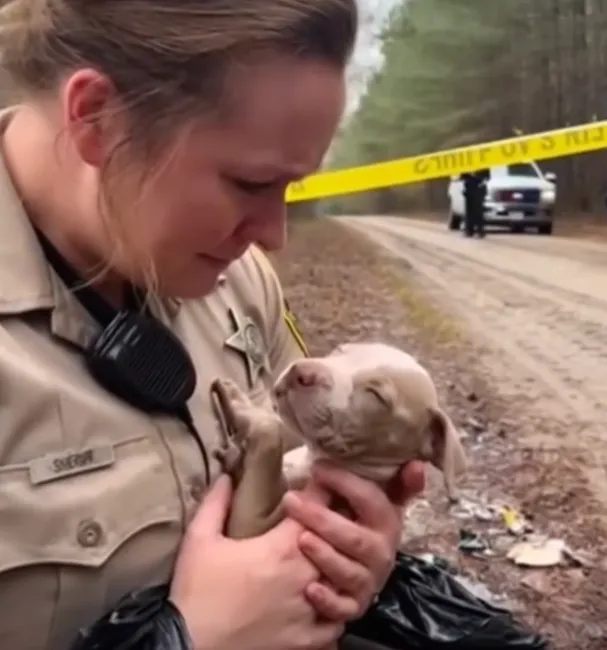
They were puppies, no more than a few weeks old.
Their fur was matted, their paws limp, their eyes shut as if still waiting for warmth.
The sight punched the air from her lungs harder than any foul odor ever had.
Elena reached in, intending only to count them, to bear witness.
She didn’t want them to be just “contents of bag four” on a report.
That was when one of the “bodies” shivered beneath her hand.
Buried beneath dead littermates, a small chest fluttered weakly.
It wasn’t a steady rise and fall, just a trembling fight for air.
Elena dropped to her knees on the dirty concrete, all training abandoned.
Protocol said call it in and wait for backup.
Protocol said gloves, distance, documentation, proper chain of custody.
But protocol had never accounted for a heartbeat refusing to quit.
She tore her gloves off and reached in with bare hands.
The puppy’s fur was damp, cold, and sticky from the bag’s condensation.
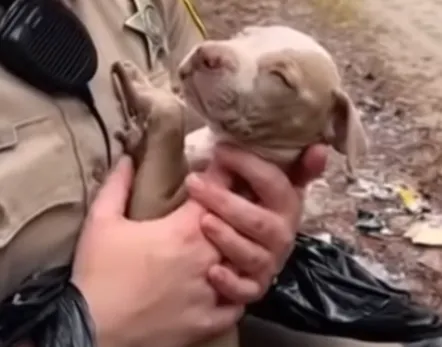
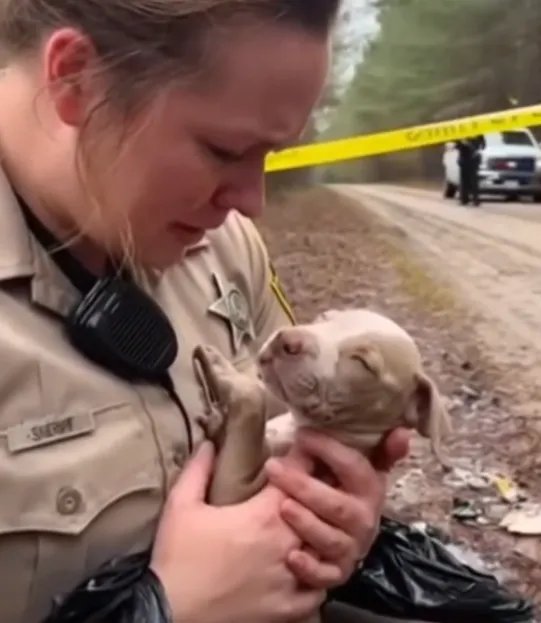
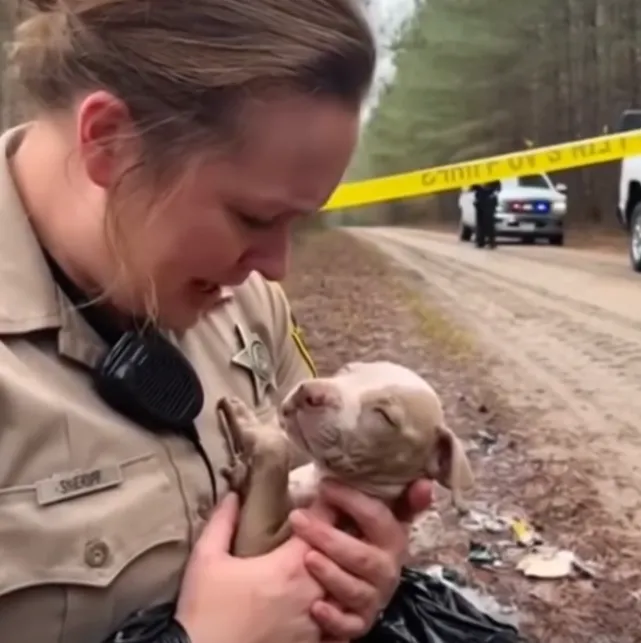
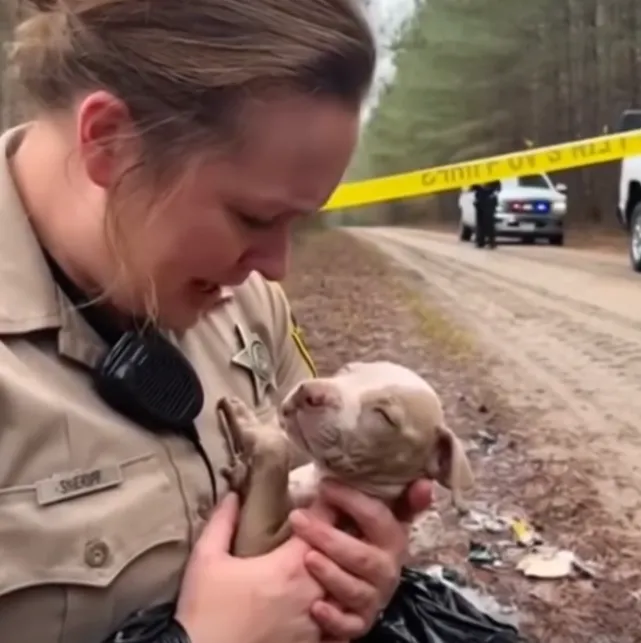
She pulled him free and pressed him clumsily to her chest.
“I’ve got you,” she whispered, voice cracking.
“You’re safe now.
I’ve got you, okay?”
The puppy’s head lolled against her collarbone.
His body shook in tiny spasms, but he didn’t let go of breathing.
Somewhere near the entrance, a truck backed up and beeped, oblivious.
“Elena, you good over there?” someone shouted from behind a pile of discarded pallets.
Her coworker’s voice floated in, casual, unaware that everything had changed.
She couldn’t answer yet, not until she knew he was still fighting.
She bent her head, cheek brushing his damp fur.
He smelled like plastic, rot, and something faintly milky beneath all that ruin.
Her mind, usually efficient and organized, could only repeat one thought.
Not this one.
Not today.
Not on my watch.
The puppy’s breaths came in shallow, ragged pulls.
Each one sounded like a question he wasn’t sure how to ask.
Elena reached for her radio with one shaking hand.
“This is Elena by bay three,” she said, forcing her voice steady.
“I need someone to cover my load-out.
I’ve got… I’ve got a live animal here.”
Animal control would normally handle this.
There were forms, procedures, designated transports, everything built for neat boxes.
But nothing about this felt neat, or clinical, or distant enough for forms.
She wrapped the puppy in the front of her safety vest.
His tiny body pressed against her, heat slowly leaking into him.
Every time he trembled, something inside her flared like a match.
Vets later called it a miracle.
Elena, in that moment, called it a promise she hadn’t yet spoken aloud.
She just knew she wasn’t letting go.
The drive to the emergency vet clinic blurred.
Streetlights streaked by, a smudge of yellow against the deepening evening.
She drove one-handed, the other pressed protectively over her chest.
“Hang on, little guy,” she murmured at every red light.
“You didn’t come this far just to stop now.
Not after all that.”
At the clinic, they rushed him from her arms.
A vet tech with quick hands and tired eyes took him, not unkindly.
“Name?” they asked, already moving toward the back.
Elena blinked, thrown.
For a second she thought they meant the puppy’s name.
“Elena,” she said instead, feeling foolish and strangely hollow when he left her arms.
The waiting room smelled like disinfectant and worry.
A couple sat across from her, cradling a cat carrier like a fragile secret.
On the TV, muted news played footage of something terrible happening somewhere else.
Elena sat with her hands empty.
She could still feel the weight of him, light and trembling against her.
Her palms itched with the memory of his heartbeat.
Time turned syrup-thick.
She stared at the swinging door that separated “public” from “treatment.”
Every time it moved, her breath snagged for a second.
Finally, a vet emerged, mask pulled down.
There was sweat at his temples and tenderness in his eyes.
“He’s critical,” he said, not softening the truth.
“But he’s breathing on his own now.
He’s hypothermic, dehydrated, and very weak.
If you hadn’t gotten him here when you did, he wouldn’t have made it.”
Something unclenched in her chest, then immediately knotted again.
“What happens now?” she asked, voice sounding smaller than she liked.
“Does he… does he have a chance?”
The vet nodded slowly.
“He has a chance.
It’s not guaranteed, but it’s a real one.”
She swallowed, feeling the word settle into her bones.
Chance.
A thin line between lost and found.
Days later, she drove him home in the passenger seat.
He was wrapped in a soft blue blanket the clinic let her keep.
A tiny cone encircled his neck to keep him from chewing at his IV site.
He wasn’t out of the woods, not yet.
But his eyes were open now, dark and questioning.
They flicked to her every time the car turned, as if checking she was still there.
She named him Hope.
Because calling him anything else felt like a lie.
Because he was something she hadn’t let herself believe in for a long time.
Hope slept most of the way home.
Every so often, his paws twitched like he was running inside a dream.
Elena found herself glancing at him more than at the road.
Her apartment had never looked smaller than when she carried him inside.
She’d always thought of it as temporary, a place between who she was and who she might become.
Now it felt like something else—a shelter, a starting point.
She set up a makeshift bed in a cardboard box.
Old towels, the clinic blanket, and a T-shirt she didn’t mind sacrificing.
Hope sniffed at it once, then promptly tried to crawl into her lap instead.
“You’re supposed to be resting,” she scolded gently.
He looked up at her with those impossibly serious eyes.
Then he collapsed against her leg like she was the only solid thing in the world.
In the weeks that followed, Elena’s life reshaped itself.
Morning alarms shifted earlier, not for work, but for feedings and medication.
Evenings stopped being a blur of exhaustion and empty scrolling.
Instead, they became walks—short, careful ones at first.
Hope’s legs were wobbly, his gait uncertain, but his curiosity fierce.
Every fallen leaf, every distant sound, every passing stranger drew his attention.
The scar of where the IV had been slowly disappeared beneath soft fur.
His ribs, once sharp ridges under her hand, thickened with healthy weight.
The light in his eyes grew steadier, less haunted by whatever came before the bag.
There were still flashbacks—though not just his.
Sometimes a rustling trash bag at work made Elena’s stomach twist.
Sometimes she would wake at night certain she had heard that ragged, almost-not-there breath again.
At the dump, news of the puppies had circulated fast.
Coworkers started greeting her with quiet nods and softer eyes.
Someone taped a flyer about reporting animal cruelty near the break room coffee machine.
Violence had always been part of the job’s background noise.
Furniture smashed in anger, clothes tossed away after fights, photos shredded and discarded.
Now, though, it felt closer, more personal, given shape by a small body.
The city opened an investigation into the dumped litter.
There were security cameras, partial license plates, a list of possible suspects.
For weeks, Elena’s phone buzzed with updates she wasn’t sure she wanted.
They showed her still images of a car backing up to the drop site.
Headlights cutting across concrete, a trunk opening, a dark shape being lifted.
Every time she saw it, her jaw clenched until her teeth ached.
“How do you do this?” she asked the lead investigator one afternoon.
They were standing where she’d found the bag, the air thick with sun and dust.
“How do you look at this and not drown in anger?”
The investigator considered her for a long moment.
“You don’t avoid it,” he said finally.
“You let it pass through you, and you hold onto the ones you can save.”
She thought of Hope, asleep at home with one ear flipped inside out.
Thought of how his whole body wagged now when she walked through the door.
Thought of the way he’d started pushing his head under her hand whenever she got too still.
Saving one didn’t erase the ones she couldn’t.
It didn’t make the world kinder overnight or undo the cruelty of whoever tied that bag.
But it gave weight to the idea that doing something mattered.
On the darkest days, Elena remembered another time she’d been too late.
A sister she hadn’t talked about in years.
A hospital room that smelled like antiseptic and unfinished apologies.
Back then, she had promised herself not to feel so deeply again.
Not to be the one who held on the longest when everyone else had stepped away.
Detachment had become her shield, her way of making it through shift after shift.
Hope didn’t care about shields.
He only knew that when thunder rattled the windows, he needed to climb into her lap.
He only knew that when she came home smelling of diesel and dust, he pressed his nose to her wrist as if counting her pulse.
He followed her from room to room.
If she sat, he curled against her feet.
If she cried—on the rare nights she let herself—he licked her knuckles until she laughed through tears.
“You were thrown away,” she would tell him sometimes.
“You were buried alive and left to die.”
“And somehow you still trust anyone enough to wag your tail.”
On social media, the story spread further than she expected.
A coworker posted a photo of Hope’s first day sitting up on his own.
Within hours, there were comments from strangers across the city and beyond.
People called him “Trash Bag Miracle” and “Little Phoenix.”
They offered donations for vet bills, toys, leashes, tiny sweaters he refused to wear.
Some shared stories of their own rescues, their own small lives they’d pulled from the edge.
One message stood out from the others.
It came from a woman Elena had never met, her profile picture a simple candle.
“My sister didn’t get a second chance,” it read. “Thank you for giving him one.”
Elena stared at that message for a long time.
It felt like someone had reached straight into her chest and named the ache there.
She typed, deleted, retyped, and finally sent only two words back.
“Me too.”
Sometimes that was all there was to say.
Sometimes that was the whole truth.
Months passed, and Hope grew into his paws.
He learned the sound of her truck rumbling down the street.
He learned that “stay” was negotiable but “come” was not.
He also learned that trash bags were not his friend.
If one crinkled too close, he shrank back, ears flattening.
Elena didn’t push him toward them, didn’t force him to “get over it.”
“You remember,” she murmured, kneeling beside him.
His eyes, dark and wide, flicked to hers and held.
“We both do.”
Together, they built a new set of associations.
Trash bags could also mean treats dropped in the bin.
They could mean walks to the curb where neighbors cooed over him and slipped him biscuits.
One day, Elena saw a kid from the building roughly yanking a dog’s leash.
The puppy yelped, stumbling on the sidewalk.
Before she could stop herself, she was across the courtyard.
“Hey,” she called, not shouting, but not soft, either.
The kid froze, eyes wide, caught in the act of something he hadn’t fully understood yet.
“That’s not how you treat someone you’re responsible for.”
The word “someone,” not “something,” hung between them.
She crouched, showing him how to hold the leash without hurting.
Hope stood beside her, tail wagging cautiously, as if demonstrating what trust could look like.
Later that night, she realized something had shifted again.
She wasn’t just reacting to harm anymore.
She was stepping in before it hardened into habit.
Hope snored beside her on the couch, paws twitching in some happy dream.
She ran her fingers across the soft fur where sharp bones used to jut.
“I guess this is what you do, huh?” she said softly.
“You survive something ugly.
And then you make the world a little less cruel wherever you can.
Even if it’s just one corner of one street in one city.”
Outside, a trash truck rumbled past, performing the same work she did every day.
Collecting what others threw away, moving it out of sight.
But not everything broken needed to disappear.
Some things needed a second look, a second chance, a pair of hands that refused to close.
Elena had expected that last bag to be the end of her shift.
Instead, it had been the start of something she’d never planned for.
Vets would keep calling it a miracle.
Their charts and notes would say “critical,” then “stable,” then “thriving.”
But when Elena woke up each morning to a wet nose nudging her hand, she called it something else.
She called it a promise kept.
To a tiny heartbeat she refused to walk away from.
To the part of herself that still believed—not in perfection, but in possibility.
And every time she whispered his name, she remembered the moment she first chose him.
Hope, wrapped in plastic, buried and fading, but not yet gone.
Hope, now sprawled across her bed, claiming space like he’d been born to it.
Hope, once thrown away, now teaching her how to hold on.