My name is Delphina Okafor, and I work as a dedicated home health aide in Akron, Ohio, sharing a small, peaceful house on a quiet suburban street with my bright six-year-old daughter Jessamy, who is in first grade, has an adorable gap in her front teeth, and possesses an endless fascination for collecting rocks.
Right next door lived Mrs. Ulrike Brandt, an eighty-four-year-old widow who had lived alone for years, bravely managing her diabetes and bad knees with the help of a walker while faithfully sitting out on her front porch every single afternoon to wave cheerfully at the local school children.
However, as the months passed, Mrs. Brandt suddenly stopped coming outside altogether, and the only frequent visitor she received was her distant son Dimitri, who lived across town and dropped by perhaps once a month—always shouting angrily through the thin walls about selling her house and forcing her into a nursing home.
In September, I began noticing a peculiar routine with my daughter Jessamy, who would step off the school bus every afternoon, announce excitedly that she would be right back, and vanish out of sight for exactly ten minutes before returning breathless and smiling, stubbornly refusing to reveal where she had been.
Around the same time, I started finding mysterious items missing from our kitchen cabinets—juice boxes, individual snack crackers, jars of peanut butter, and occasionally an entire fresh banana—which I initially brushed off as normal childhood hoarding habits typical of a curious six-year-old.
Yet as four long weeks stretched into four full months of secret afternoon excursions, a persistent knot of worry began to form tightly in my stomach every single day at 3:40 PM when the yellow school bus doors hissed open.
The unsettling mystery came to an abrupt, aggressive head in January when a heavy fist pounded furiously on my front door, revealing a red-faced, tight-jawed Dimitri in his work jacket demanding to know if Jessamy was my child.
Without giving me a chance to speak, Dimitri aggressively accused my little girl of trespassing in his mother’s kitchen, scattering crackers everywhere, and tearing open candy wrappers, threatening to call the police immediately and report me for sending my daughter over to steal if he ever caught her near the property again.
Though my first instinct as an angry mother was to yell right back at him, I had learned long ago that escalating conflicts with hostile strangers never solved anything, so I simply kept my composure and told him okay.
That very afternoon, however, when the school bus pulled up and Jessamy hopped down with her familiar declaration, I waited ten seconds and quietly decided to follow her across the yard, watching as she ducked through the familiar gap in the overgrown hedge.
To my complete shock, she ran straight to Mrs. Brandt’s back door, reached deep into her coat pocket, pulled out a spare house key attached to a cheerful pink ribbon, unlocked the heavy wooden door, and slipped quietly inside.
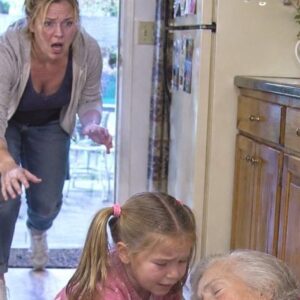
My heart slamming violently against my ribs, I hurried across the yard, pushed the back door open into the dark, stale-smelling kitchen, and found my daughter kneeling on the linoleum floor next to a tipped-over walker.
Lying motionless on her side between the kitchen table and the refrigerator was Mrs. Brandt, pale, covered in sweat, and barely breathing, while little Jessamy desperately pressed a juice box to her lips and begged her to drink the apple one.
Looking up at me with eyes swimming in tears, my daughter whispered the words that froze my blood: “Mommy, she fell down yesterday, and she won’t get up.”