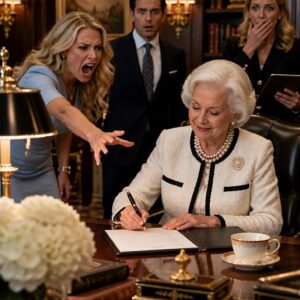
The following morning, Daniel made pancakes with the children while I sat comfortably at the breakfast counter, watching him struggle to clean up his own minor mistakes.
Later, he called Claire to discuss their escalating financial situation, and she immediately returned to her obsessive subject of selling my home.
“Claire, Mom isn’t selling her house,” Daniel told her firmly over the phone.
“So that’s it? You’ve chosen her over us?” she snapped back.
“No, Claire. I’m choosing not to take something that doesn’t belong to us.”
For the very first time in my life, I heard my son acknowledge a firm boundary without asking me to remove it for his convenience.
At attorney Miriam’s office, we carefully reviewed the disputed business guarantee, the unauthorized bank transfers, and all other available financial records.
Miriam explained that the forged signature required a thorough investigation and that we needed to formally notify the lender of potential fraud.
She also requested that all original application records and electronic correspondence be preserved immediately, and Daniel agreed to cooperate fully.
“Will they lose their house?” I asked Miriam privately with a heavy heart.
She explained that the final outcome would depend entirely on their existing obligations and the arrangements they could successfully negotiate with the lenders.
I felt the familiar, heavy urge to offer Daniel financial help, but I reminded myself that protecting my grandchildren did not require paying every single debt their parents had recklessly accumulated.
The following weeks brought agonizingly difficult conversations, legal notices, and deep financial reviews as Daniel accounted for the money taken from my accounts.
The disputed guarantee required a separate, intense investigation, with records indicating the document had been uploaded through the broker’s system directly from Claire’s business account.
Eventually, a formal meeting was arranged with the lender’s representatives and their respective legal counsels, where Claire arrived wearing a dark blue suit, looking polished but visibly exhausted.
The representative examined the disputed document before asking her a direct, terrifying question: “Did Mrs. Bennett agree to guarantee this financial obligation?”
Claire hesitated for a long moment while her attorney whispered quietly to her, before she finally lowered her head in defeat.
“No,” she whispered.
The representative then asked why my legal name had been included on the binding paperwork without my consent.
Claire reluctantly acknowledged that she had arranged for the fraudulent guarantee to be submitted without ever obtaining my direct approval.
She babbled an excuse about the business struggling and expecting the loan to be repaid before anyone needed to rely on the guarantee.
Then came the final question I had been dreading all morning: “Was the signature actually Mrs. Bennett’s?”
Claire looked down at the polished wooden table. “No.”
The woman who had repeatedly questioned my judgment and mental clarity had been secretly hiding a catastrophic financial decision that put my home directly at risk.
I struggled desperately to control my raw emotions, remembering how for years I had cared for her children, prepared her meals, and helped maintain the comfortable illusion of her life.
“Why would you do that to me, Claire?” I asked, my voice trembling.
“I thought we’d fix everything before it became a problem,” she sobbed.
“You didn’t have my permission.”
“I know.”
“You used my name and put my home at risk.”
Tears began rolling down her cheeks as she admitted she had been utterly terrified of losing their high-end lifestyle and having people discover how severe their financial problems had become.
I felt a quiet compassion for her deep fear, but I could never excuse her deliberate, deceitful decisions.
The lender confirmed that the disputed guarantee would not be enforced against me while the matter remained under active criminal and regulatory review.
Near the elevators on our way out, Claire stopped me and offered a weak apology, admitting she had convinced herself Daniel and the children needed my house more than I did.
“I was wrong, Maggie,” she whispered.
“Yes, Claire. You were,” I replied.
I told her I hoped she received the professional help she desperately needed, but that she would never again have access to my finances or my property.
Daniel and Claire eventually separated, and unable to maintain their expensive house, they arranged its quick sale with assistance from their lenders and independent advisers.
Daniel sold his luxury car, closed his failing business, and moved into a modest apartment where he found steady employment with a smaller company.
Claire moved into her own apartment to address the severe legal and financial consequences of her involvement in the forged paperwork.
Their difficulties did not vanish overnight, but they were finally taking full personal responsibility for problems I had spent years trying to solve for them.
Noah and Lily continued spending time with both parents through structured visits, and I made sure they understood they could love every member of their family without choosing sides.
As winter approached, I happily rediscovered parts of myself I had almost forgotten, playing the piano, attending pottery classes, visiting the library, and enjoying long lunches with Joan.
Before Christmas, Daniel called to ask if he and the children could come over for a quiet family dinner.
“Of course,” I said. “But this year, I’m not cooking everything alone.”
He laughed softly over the line. “Actually, Mom, I was hoping I could make the dinner myself.”
On Christmas morning, I opened the old wooden box containing Richard’s loving letters, and one message reminded me that I deserved a home, rest, and a permanent chair at every table where I was called family.
Daniel arrived at noon carrying grocery bags, with Noah bringing a wrapped package and Lily hurrying inside holding a handmade paper snowflake.
Daniel prepared the roast while I made the cheesecake, helping only when asked without taking over the kitchen.
The children decorated the dining room table with festive red napkins, glowing candles, and handmade place cards, including one featuring a blue flower at the head of the table marked GRANDMA MAGGIE—Richard’s old chair.
Tears filled my eyes as Daniel stood behind us with wet eyes, looking at the place card before turning toward me.
“Mom, I owe you an apology,” he said sincerely, admitting he had treated my presence as less important than my services.
“I’m sorry I made you feel that being useful was the price of belonging.”
We ate together that evening, and though the roast was slightly overdone, I enjoyed every single bite.
Later, Noah handed me a framed photograph of the four of us taken that afternoon, beneath which he had written: Grandma, you always have a place with us.
From the kitchen, I could hear Daniel washing the dishes—something I had done for him countless times without being asked.
I looked toward Richard’s framed photograph and smiled proudly, finally understanding at sixty-eight years old that true love never requires exhaustion, surrender of independence, or self-sacrifice to deserve respect.