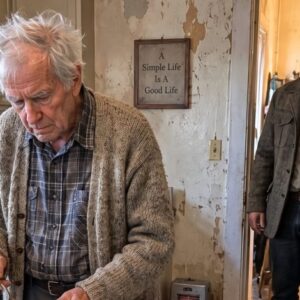
The older officer closed the screen after reviewing enough to understand what had happened, while my brother Aaron stood abruptly and looked toward the hallway, demanding a lawyer as he was placed in handcuffs.
Dad tried to follow the officers onto the porch, speaking in the same reasonable, patient tone he believed could settle everything, but for the first time in my life, his rehearsed explanations carried no weight against the digital evidence.
In the following days, relatives began calling with questions they should have asked long ago, some apologizing while others tried to explain Dad’s behavior through his past, as though understanding his personal history would somehow excuse what he had chosen to do.
When my mother called and cried so hard that I nearly began comforting her the way I always had when our family became uncomfortable, I caught myself just in time, remembering Dad laughing while I lay helpless on the floor.
Listening to my mother on the line, I realized how easily I could be pulled back into protecting them from the consequences of their own actions, and for once, I allowed the frightening reality of what had happened to remain entirely unsoftened.
Weeks later, I returned to the house accompanied by an officer and a close friend to collect the rest of my belongings, determined to take what was mine without falling back into another conversation my father could control.
The hallway wall had been neatly repaired where my face had struck it, and the broken photograph of our smiling family was gone, but the room still held the heavy, suffocating memories of a place where I had learned to fear my own voice.
Standing inside my old bedroom for the last time, I looked up above the bookshelf where the smoke detector had once concealed the tiny camera, leaving a pale, round circle on the ceiling that no longer held any power to make me feel unsafe.
The camera was gone, but its absence could not erase what it had preserved, and I no longer needed a hidden lens watching over that room because I was finally collecting my things and walking away for good.
For years, I had tortured myself trying to remember every detail clearly enough to survive my father’s interrogation, knowing how quickly a moment of hesitation could become proof in his telling that I was unstable and confused.
The recordings did not have that vulnerability, because my father could lower his voice, invoke his authority, or insist he knew his daughter better than anyone, but none of his words could alter the unedited truth stored on that memory card.
When I walked out of the Kensington house for the final time, I did not slam the door behind me and I did not offer a parting apology, carrying instead my belongings and the ultimate freedom of no longer needing to protect the people who had hurt me.
That footage could not rewrite my childhood or completely undo the terror of that night, but it permanently ended the argument over whether I was allowed to trust my own lived experience.
I no longer needed to stay where I had spent years begging to be believed, and as I drove away toward a quiet future, I finally knew what it felt like to be completely, unshakeably certain of the truth.