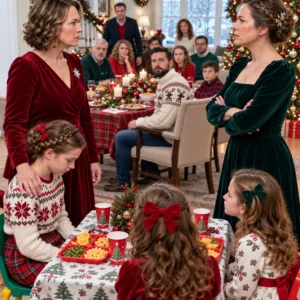
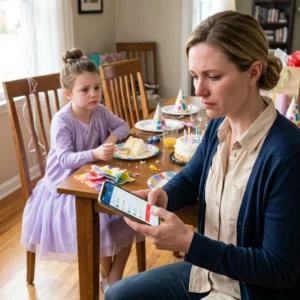
The drive home carried the heavy kind of silence—the kind that isn’t peaceful, only deeply uncomfortable. Adam kept his attention on the road, while Olivia stared silently through the window.
Back home, when Adam asked what happened, Olivia spoke for the first time, her voice barely a whisper: “They said Madison’s smarter than me, funnier, better… that I’m annoying.” She blinked hard, trying to hold back her tears. “But it’s okay. It’s probably true. She really is smarter than me.”
Her words nearly broke my heart. I knelt before her, holding her cold hands: “None of that is true. They weren’t being truthful. They were being unkind. Jokes that hurt people aren’t jokes at all.”
That night, something inside me finally snapped. I wasn’t going to stand quietly with a tray in my hand while my daughter became their newest punchline. I pulled my laptop across the kitchen table and drafted a professional, firm legal notice.
Monica and her family had 30 days to vacate the house. I was selling it.
THE FALLOUT AND THE TRUTH REVEALED
Three days later, my phone rang. It was Monica, screaming through the speaker: “You’ve completely lost your mind! You seriously think you can make us leave like strangers because of a joke?! This is ridiculous, Hannah. You’ve always been too sensitive!”
“This isn’t a joke,” I replied, my voice steady and cold. “You have 30 days. I’m selling the house.”
“You can’t sell it! We live there!”
“My name is on the deed. Not yours.”
Later that evening, Mom called, trying her sweetest, most manipulative voice: “Hannah, sweetheart, think about Madison. She needs stability. You’ve always been the generous one. Don’t throw that away because of one unfortunate evening.”
“This isn’t about one evening,” I answered evenly. “It’s about Olivia and years of being treated like we don’t matter. The letter stands.”
Mom’s sweetness instantly vanished: “You’ll regret this!” she snapped before slamming the phone down.
Day 30 arrived cold and gray. When I drove down their street, a large moving truck was already parked outside. Monica’s husband carried boxes down the steps, while my parents barked orders like commanders.
When they saw me step out of my car, Mom and Dad hurried toward me, followed closely by a furious Monica.
“How could you do this to your own sister?” Mom demanded. “To all of us? Over nothing more than words!”
Monica pointed a shaking finger at me: “You were always jealous, always different. You never belonged here!”
The words settled heavily in my chest—familiar, painful words. I straightened my posture and kept my voice ice-cold: “So that’s really it? All these years… I never belonged.”
Mom’s expression hardened entirely, dropping any remaining pretense of maternal affection: “You were never like us. You never fit in. And yes, perhaps you tried to buy your place in this family. But that was your decision.”
Everything around me stopped. It was something I had suspected all my life, spoken aloud at last.
“No,” I said quietly, looking each of them in the eye. “That was me trying to believe I mattered to you. And now I understand. You never valued me the way I hoped, and I’m finally done chasing your approval.”
Without another word, I turned around, climbed back into my car, and drove away.
TRUE PEACE AND FREEDOM
A year later, Olivia came home from school, dropped her backpack by the door, and said casually: “Remember that friend who was always making little jokes about me? I don’t sit with her anymore. I realized she wasn’t actually a good friend.”
She smiled brightly. “I spend time with someone new now. She likes the same books I like. She doesn’t laugh at me. She laughs with me.”
I nearly cried tears of pure joy. For the first time, Olivia understood something that took me decades to learn: you don’t have to keep people close when they constantly make you feel small.
As for my family, I eventually learned through extended relatives what happened next. After moving out, Monica and her family returned to live with my parents, but the crowded roof lasted only two months before constant arguments broke out. Eventually, they moved into a smaller rental in a rougher part of town. Monica was forced to work a full-time job she hated, her husband took on grueling physical labor, and Mom and Dad ended up financially supporting them—the exact same burden I had carried for years.
The irony wasn’t lost on me. They had chosen Monica over me, and now they were paying the price.
One afternoon, I watched Olivia curled up on the couch beside her new best friend, giggling over a shared book. The sound filled our house with something I hadn’t experienced in my entire childhood: absolute, unbreakable peace.
I never needed their acceptance in the first place.