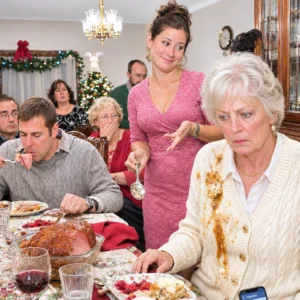
“I only set the table for people who actually belong here.”
My sister-in-law, Susette, uttered those venomous words to my seven-year-old son, Caleb, on Christmas Day as he stood in the middle of her elegant dining room holding a plain, empty plate.
He had circled her beautifully decorated mahogany table twice, scanning the handwritten silver-embossed place cards in search of his own name, only to realize there was no place designated for him, his little sister Lily, my wife Nadia, or me among the fourteen pristine chairs.
The relatives seated around the feast deliberately looked away: my mother stared rigidly down at her cloth napkin, Uncle Pete froze with his water glass halfway to his mouth, and my older brother Garrett—Susette’s husband—simply closed his eyes in cowardly resignation.
That was the exact moment that broke something fundamental inside me: Garrett knew precisely what his wife had been doing year after year, yet he consistently chose silence over defending his own flesh and blood.
My name is Wesley Bennett, a thirty-four-year-old father and small-business owner who runs a catering company in northern New Jersey, where managing seating charts, accommodating unexpected guests, and ensuring everyone feels welcome are fundamental daily responsibilities.
I know the distinct difference between an innocent oversight and a calculated, malicious omission—and for six consecutive Christmases, Susette had engineered a quiet, systematic campaign to banish my family to the margins of our family gatherings.
It began innocently enough during our first holiday at her newly purchased Ridgewood colonial home, when she claimed she had “miscounted” and seated us at wobbly folding chairs near the kitchen doorway with paper napkins while everyone else enjoyed cloth linens.
With each passing year, the exclusions grew progressively more humiliating: a separate children’s table in the living room while empty dining chairs sat untouched; a card table pushed out into the cold hallway; Nadia forced to eat alone in a dark den beside a silent television while nursing our infant daughter; and finally, on our sixth year, all four of us relegated to an unheated, freezing sunroom where our children had to keep their winter coats zipped up tight throughout Christmas dinner.
Each time, well-meaning relatives urged us to keep the peace, and I foolishly made excuses for my brother’s weak spine, falsely believing that enduring the disrespect was a small price to pay to keep the extended family together.
But as we drove toward Ridgewood on that fateful Christmas morning, my wife Nadia reminded me of our strict agreement: if Susette pulled even a single stunt with the seating this time around, we were packing our bags and walking out forever.
Little did we know, Susette had saved her most breathtaking act of cruelty for last—and the bitter harvest of her exclusionary games was about to blow our entire family apart in front of everyone.