Standing frozen in Susette’s meticulously decorated Ridgewood dining room on Christmas Day, my seven-year-old son Caleb looked up from his empty plate with wide, confused eyes and asked the question that shattered six years of polite endurance: “Daddy… do I not belong here?”
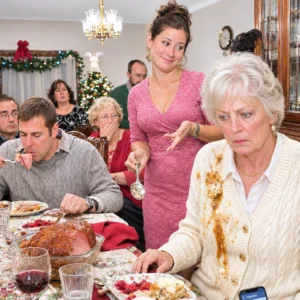
The cruel words Susette had just delivered aloud—“I only set the table for people who actually belong here”—hung heavy in the stifling air, while the rest of our relatives sat in stunned, cowardly silence, staring intensely at their matching cloth napkins and silverware.
My older brother Garrett, Susette’s husband, avoided my gaze entirely, proving once and for all that his prior silence wasn’t born of mere embarrassment, but of a deliberate choice to let his wife treat my family as invisible outsiders.
Gently reaching down, I took the empty plate from my son’s small hands, crouched down to his eye level, and told him the absolute truth: “Listen to me, Caleb. You belong with us. You belong anywhere your mom and dad are.”
Standing back up and looking directly at my wife Nadia, who had just rushed in from the kitchen, I spoke the words we should have uttered years ago: “Kids, get your coats. We’re leaving.”
Susette scoffed dismissively, waving a hand in the air. “Oh, for heaven’s sake, Wesley, don’t be so dramatic over nothing.”
Even my mother, Marilyn, tried to intervene out of misplaced habit, pleading with us not to spoil the holiday, until I looked straight into her eyes and asked, “Mom, whose holiday? Because Caleb’s Christmas has already been ruined.”
Without another word of argument or shouting, Nadia, the children, and I simply turned around and walked out the front door, leaving the twelve glittering place settings, the silver candlesticks, and the hollow family gathering far behind us.
As we stood on the snowy front porch trying to comfort a confused Caleb, my uncle Pete suddenly emerged through the front door wearing his winter coat and carrying a foil-covered dish of Susette’s mashed potatoes, announcing bluntly to everyone inside: “Your sister-in-law has good mashed potatoes… so I’m taking mine with me.”
Pete’s quiet rebellion broke the dam: moments later, my mother and father walked out declaring they were done pretending everything was fine, followed shortly by Aunt Diane and several other relatives who realized that sitting at a table built on humiliation wasn’t a holiday worth celebrating.
Packing into our vehicles, we headed not back to a somber afternoon, but to a spontaneous, beautiful feast at our own home, where my commercial kitchen manager Rosa helped us pull together leftover holiday trays, and Caleb proudly spent the afternoon writing handwritten name cards—including one that simply read WELCOME—for every single relative who chose love over cruelty.
When Garrett eventually showed up at our front porch hours later complaining that Susette was furious and claimed we had “stolen Christmas,” he walked into a crowded, warm house overflowing with nineteen chairs, mismatched silverware, and genuine laughter.
Handing us a crooked paper name card he found on the table with his own name written in a child’s uneven handwriting, Garrett stood silently among the people who actually mattered, finally understanding that true family is measured not by how many expensive chairs surround a mahogany table, but by whether anyone is ever made to feel unwelcome.
From that day forward, Christmas belonged to everyone, our extra chair remained permanently open for whoever needed a seat, and our children never had to wonder again whether they belonged.