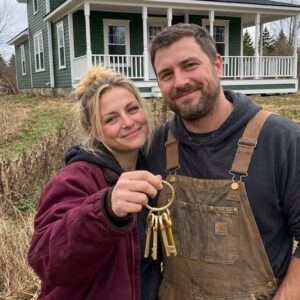
Nate drilled through true oak studs, rewiring the entire house by headlamp night after night. I pulled five layers of old wallpaper until my thumbs split open, taped them up, and headed straight to my night shift at the truck stop diner.
We kept our purchase a complete secret, wanting to present a finished home rather than a cry for help.
One afternoon in June, my phone rang at my desk at the hospital. It was Nate’s eighty-eight-year-old grandmother, Opal, who read the county newspaper’s legal notices every day with a magnifying glass.
“The paper says Nathan and Emily bought a house on the north road,” Opal said strictly. “Is that the Miller place?”
“Yes, ma’am, but it’s not safe yet,” I hesitated.
“Come get me Sunday after church,” she commanded. “And don’t tell Ronald.”
THE SECRET OF THE HOUSE
On Sunday, I brought Opal out to the property. Walking through the dusty front room, her feet moved as if she already knew every inch of the floor plan.
She walked into the kitchen, touched the old dark door frame of the pantry, and began to cry quietly—a woman I had never seen shed a single tear in eleven years.
“Emily,” Opal whispered, her thumb running along the wood. “Did nobody ever tell you whose house this was?”
“The Millers’,” I answered.
“Before that, it was Henry Brandt’s… my father’s,” Opal said softly. “He built that porch with his own hands. I was born in that back room in 1937.”
Nate held up his flashlight, revealing pencil marks carved directly into the varnish—a ladder of level lines marking family heights over decades: Opal, six years, 1943… Opal, nine years… Opal, twelve.
And near the bottom, in a mother’s handwriting: Ronnie, four years, 1960.
Opal told us how the farm was lost to the bank in 1961, auctioned off on the very same courthouse steps where Nate and I had stood sixty years later. Five-year-old Ron had stood in the yard holding his father’s hand as everything was sold, a deep family trauma they buried forever out of pride.
“And you two children went and bought it back with your own money,” Opal wept. “Without asking a single person for help.”
THE HEALING OF A FAMILY
Opal called her son Ron that Monday morning, ordering him to drive her out to the property on Saturday.
When Ron arrived, the big, quiet man stood frozen in the driveway, looking at the house he hadn’t faced since he was five years old. Seeing the new electrical meter and learning about our two years of grueling double shifts, tears filled his eyes.
“You should’ve told us you wanted a house,” Ron said, his voice choking up. “Capable people get tired too, Ron,” I said gently. “It didn’t come easy because we’re us—it came hard, and we did it anyway.”
The following Saturday at seven in the morning, Ron’s truck pulled up, its bed filled with sawhorses, bottle jacks, and carpenter tools.
“Help is for people who are drowning,” Ron said, looking at me straight in the eyes. “It never came into my head that help is for the ones who are swimming hard, too. I’d take it as a kindness if you’d let me work on this house.”
For eleven Saturdays, Ron and Nate worked side by side, jacking up the porch roof, making custom fir pillars, and restoring the old kitchen cabinets. Judy made curtains for nine windows and apologized with tears in her eyes for the Easter card, while Kim, Jeff, and Stacy came out to help paint and lay water lines.
On the final Saturday, Ron took a carpenter’s pencil, stepped into the pantry, and marked a new line on the door frame above all the old ones: Nate, 36 yrs, 2026.
Then he handed the pencil to me, and I marked Ron right beside his mother’s childhood lines.
We moved into our ancestral home that autumn, leaving the hard years behind us. We didn’t need a hand-out—we only needed to be seen, and in rebuilding those old walls, we rebuilt our entire family.