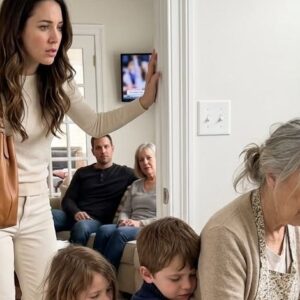
Lauren first consulted a child psychologist in Manhattan, Dr. Marlene Sutter, who destroyed my expectation of quickly making up for lost years in less than ten minutes: “You can’t get six years back. You can build the next ones.”
The conversation with the boys took place on a Saturday. Mason fired the first question: “Mom says you’re our father. Did you know we existed?”
“No.”
“Why not?”
I had promised myself I wouldn’t burden four six-year-olds with adult mistakes. “Because there were people who kept your mother and me from being able to talk. When you’re older, you’ll learn more about the details.”
Henry asked almost in a whisper: “Are you going to disappear again?”
That question hurt more than any accusation. “No. I can’t promise I’ll never make a mistake, but I can promise I won’t disappear without telling you where I am.”
Theo raised his hand: “I want a DNA test.”
The test confirmed paternity with virtually absolute certainty, and Theo studied the report before accepting the result: “Okay. Now we have data.”
EARNING THE TITLE OF DAD
There were no mansions handed over, but two-hour afternoons, games in the park, homework, snacks, and arguments over video games. I discovered that Mason needed a night-light, Henry drew when he was worried, Theo asked endless questions, and Wyatt turned every room into an experiment—once trying to put cereal inside a toaster because “Theo said heat transforms matter.” When I unplugged it, Wyatt looked disappointed: “Dad ruined it.”
I froze. Dad.
I walked to the bathroom, closed the door, and cried sitting on the edge of the tub for several minutes. I never demanded that the other three use that word; Henry took months, Theo saved it for when he needed something, and Mason took almost a year. I finally understood what Lauren meant: being a father didn’t begin with a genetic test, but with showing up on Tuesday after showing up on Monday.
Meanwhile, the Ashford structure was cracking. My mother demanded to meet her grandchildren, but I refused, presenting copies of the fake transfer, handwriting report, and messages sent to Lauren: “Go ahead and bring lawyers. But all of this stops being private.” She understood.
Blair and I maintained a cordial relationship after she realized we were going to marry last names rather than people; she started her own investment firm and thrived.
BUILDING OUR OWN WORLD
For almost two years, Lauren and I were simply the parents of the same children while I started therapy, sold my stakes in opaque family businesses, and stopped using the Ashford name as an excuse. The first time we kissed again was after Mason broke his arm playing soccer. When we got back from the hospital, Lauren stayed in the kitchen, terrified of everything that could have gone wrong. I put my arms around her, and when she raised her face, we both understood. The kiss lasted only a few seconds before she stepped back: “We can’t pretend six years disappeared.”
“I don’t want to,” I said. “Let’s build our own world.”
Years later when the boys turned ten, we finally explained how their grandmother’s wrong decisions had kept us apart. My mother was granted permission for a single visit without gifts, where Mason was direct: “Why didn’t you let Dad get to know us? Did you know we existed?”
My mother lowered her head: “Because I was too used to people doing what I said.”
The relationship took years to build and didn’t have to be perfect. When the boys turned ten, Lauren finally agreed to marry me: “It means we could build something of our own.” The proposal happened in the kitchen with Mason giving a speech, Henry drawing a card, Theo writing a list of “Reasonable Risks of Marriage,” and Wyatt hiding the ring inside a cereal box.
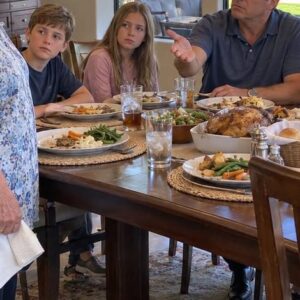
Decades later when Lauren and I celebrated thirty years of marriage, Wyatt reserved a private room at the same Manhattan restaurant where it all had begun, surrounded by our sons, their partners, and several grandchildren. During dinner, a detail came out that Lauren had never shared: “That day, I had decided to move back to Charleston with the boys after lunch.”
I set my glass down: “So the next day you wouldn’t have been in New York?”
“Probably not.”
Wyatt smiled: “The story just got a lot better.”
Later, I went to the bathroom. As I washed my hands, I looked at my reflection and remembered the thirty-seven-year-old man who had walked in there decades earlier convinced he controlled every detail of his life—until four boys walked in arguing. This time, they were my grandsons. One had Lauren’s eyes, and another rubbed the back of his neck exactly like me.
“Grandpa, we can’t reach the soap.”
I helped them. Nothing extraordinary—water, soap, and four small pairs of hands. When I came out, Lauren was waiting by the door just like that first night: “Did you take long?”
I stood there looking at her. She understood immediately: “Don’t start crying.”
“I’m not crying.”
“Your eyes are red.”
“Must be the soap.”
“Sure.”
The grandsons ran off, and Lauren took my hand. For years I had thought a delay and four little boys had changed my destiny, but in time I understood something different: chance had only opened a door, and everything else had been a choice. I never got back the first six years of my sons’ lives, but I learned that lost time can’t be recovered—you build new time. And it had all started in front of four sinks, proving it had been the best defeat of my entire life, because losing the life other people designed for me allowed me to finally build my own.