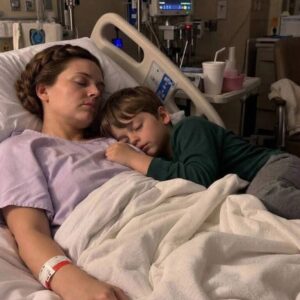
For nearly an hour, nothing happened. Noah told Emma about school, his spelling test, and Grandma burning pancakes. From the corner, Mom protested that they weren’t burned, but Noah smiled: “They were black, Grandma.” Eventually, Mom went home, and I remained beside Noah.
Around seven o’clock, I stood up to get coffee, but Noah looked up immediately: “You promised you’d stay.”
“I’m only getting coffee.”
“There’s coffee down the hall. Why do you need to leave?”
I stopped, sat back down, and realized he was right. Twenty minutes later, Noah moved closer to Emma: “Okay, Mom. Dad’s here.” He slipped his hand beneath hers: “Mom, is Dad here with us?”
We waited. Then Emma’s index finger moved. Once.
I leaned forward: “Emma?” Nothing.
Noah looked at me: “See? She said yes.”
He explained his system: one movement meant yes, two meant no. Skeptical but amazed, I asked her a test question after Noah removed his hand, and after a pause, her finger moved once again. I was stunned. Noah whispered that this had been happening for four Saturdays, and when I asked why he hadn’t told me, he looked hurt: “You wouldn’t have believed me either… because I heard you and Grandma talking about keeping me away from Mom.”
THE HIDDEN TRUTH AND THE FEAR OF GUILT
I remembered that conversation, but Noah had misunderstood our worries about his sleep as an attempt to separate him from her. Then he said something that struck me harder than anything else: “Dad, why are you always scared to stay with Mom?”
“Scared? Noah, I’m here every day.”
“I know. But you’re always leaving. You get coffee, you take work calls, you talk to Grandma, you ask nurses questions, you go downstairs… When everything gets quiet, you leave. I think you’re scared Mom will remember.”
“Remember what?”
“You two fighting before your trip.”
My chest tightened. The evening before I left for my business trip, Emma and I had argued in the kitchen because she wanted me to stay home. Although her medical emergency wasn’t caused by my trip, guilt had followed me ever since.
I took a deep breath: “Sometimes I get so busy fixing problems that I forget people need more than solutions.”
Noah looked toward Emma: “Mom just wanted you here.”
“I know that now.”
He thought for a moment and leaned closer: “Mom, do you want Dad to stay?”
Several seconds passed. Then one finger moved. Once. Yes.
I couldn’t speak. Noah smiled: “See, Dad? She wants you here.”
For two months, I’d feared she would be angry when she woke up. But watching that tiny movement, I understood something simple: I didn’t need to solve everything. I just needed to stay.
THE ROAD TO RECOVERY
Over the following days, the medical team took Noah’s observations seriously, monitoring her responses closely. That night, for the first time in weeks, Noah slept in his own bed at home while I stayed beside my wife, holding her hand and letting go of the constant need to wander the hallways.
Over the following weeks, Emma began showing small signs of improvement—an occasional movement, brief responses to familiar voices, and moments when her eyes opened. Her progress was slow, but we learned to appreciate every small change.
Noah still visited after school, but now he went home for dinner, played with friends, and laughed more. My little boy was finally becoming a child again instead of feeling like his mother’s full-time protector.
Saturdays remained special. Only now, I stayed too.
Several weeks later, Noah sat beside Emma telling her about school, then turned to me: “Dad, you ask her today.”
I smiled and took her hand: “Emma, do you think Noah will ever learn how to spell ‘separate’?”
Noah groaned: “Dad! That’s not funny!”
I laughed softly and watched Emma’s hand. Several seconds passed. Her index finger moved. Once.
Noah burst out laughing, and I laughed with him. For the first time in months, our hospital room was filled with pure joy instead of constant fear.
I looked at my son. I’d spent weeks believing he refused to leave because he couldn’t accept his condition, but I had misunderstood. Noah stayed because he believed somebody had to, and without realizing it, I had made my seven-year-old son feel that somebody was him.
I’d been visiting every day, talking to doctors, paying bills, and doing everything a responsible husband should do. But Noah had noticed what I had missed: There’s a difference between visiting someone you love and truly being present for them.
It took my seven-year-old son and one tiny movement of Emma’s finger to teach me that lesson. And this time, I wasn’t going anywhere.