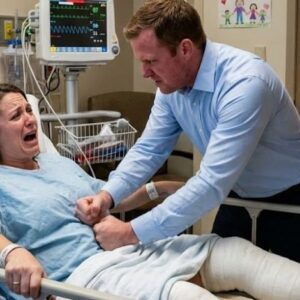
As Caleb drew his arm back to deliver another devastating blow while the heart monitor shrieked in frantic, unbroken warning tones, the heavy silver handle of my hospital door suddenly turned and clicked open.
It wasn’t a nurse checking routine vital signs, but rather Dr. Hayes accompanied by two security guards and our primary care charge nurse, who had rushed toward the room the moment the emergency panic alarms started flashing at the central nurses’ station.
Caleb froze instantly with his fist still raised in the air above my bed, his red, furious face abruptly draining of color as he tried to rearrange his expression into the mask of a concerned, exhausted husband who was merely trying to help his injured wife.
“Everything is fine here!” Caleb barked loudly, stepping away from the mattress and smoothing down his perfectly ironed shirt with trembling fingers. “We were just having a private family discussion about her discharge paperwork.”
Dr. Hayes did not even look at him, rushing straight past my husband to check the frantic monitors, gently feeling my abdomen where Caleb had struck me, and asking the nurses to administer immediate pain relief while preparing a rapid diagnostic scan for internal trauma.
One of the security guards stepped firmly in front of Caleb, blocking his path toward the door and telling him to remain right where he was until the hospital administration and law enforcement arrived.
For the first time in twenty-one days of lying beneath those sterile hospital lights feeling utterly invisible, I realized that the walls around me weren’t just holding a broken patient—they were recording unassailable evidence of domestic abuse, financial cruelty, and physical assault.
Within fifteen minutes, local police officers entered the room, taking formal statements from Dr. Hayes regarding my fractured ribs, the sudden spike in my vital signs, and the explicit medical restrictions that prohibited any independent movement, let alone forced physical extraction.
The officers also reviewed the hospital visitor logs, security camera footage from the hallway, and Caleb’s own vicious text messages demanding to know what my recovery was going to cost him, building an airtight case that left no room for his rehearsed lies.
When the lead officer asked Caleb if he had anything to say in his defense, my husband immediately pointed his finger at me and tried to claim I was unstable, hysterical, and imagining things because of heavy pain medications—the exact same gaslighting playbook he had used for eleven years of marriage.
This time, however, his words carried no power, because the medical staff, the physical bruises on my stomach, and the frantic notes in my chart spoke a language of truth he could no longer manipulate or shout down.
Caleb was formally placed in handcuffs, escorted out of the hospital room past the nurses who had quietly watched over me for three weeks, and driven directly to the local precinct on charges of domestic violence, assault, and reckless endangerment.
As the heavy wooden door clicked shut behind the departing officers, the room finally grew quiet, save for the slow, steady rhythm of the heart monitor returning to a calm, predictable beat.
Beep. Breathe. Beep.
My mother-in-law later tried to call, and distant relatives sent messages asking me not to ruin the family’s reputation over a “minor disagreement,” but I blocked every single number without a moment of hesitation.
Two months later, I walked out of that hospital on my own two feet, leaning on a pair of sturdy crutches while holding tight to the hand of my nine-year-old daughter Emma, who looked up at me with sparkling eyes and whispered, “I knew you’d make it home, Mommy.”
We didn’t return to the house where Caleb controlled every penny and kept score of my worth; instead, we moved into a bright, cheerful apartment near Emma’s school where the kitchen table was once again filled with school permission slips, laughter, and peace.
I eventually returned to accounting work, earning my own paycheck, making my own decisions, and remembering that surviving a horrific car crash was merely the universe’s way of proving that my life belonged to me.
Caleb had spent eleven years convincing me that I was a useless burden who could never survive without him, but he learned the ultimate lesson the hard way: a woman who has survived the twisting metal of a violent wreck will never again let anyone break her spirit from the inside.