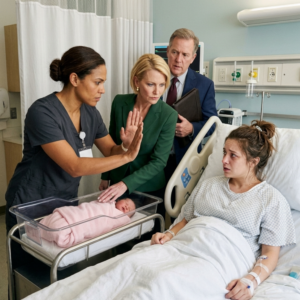
Just two days after my daughter Lily entered the world following a grueling, near-fatal delivery, my mother marched straight into my private hospital recovery room as though she owned the very air inside it—never knocking, never asking if I was awake, and heading directly toward the clear plastic bassinet with her sharp designer perfume cutting right through the smell of antiseptic.
Still tethered to a rhythmic IV drip with a tight blood pressure cuff squeezing my arm, every tiny movement sent searing waves of abdominal pain shooting through my body until white spots danced behind my eyes, yet watching my newborn daughter sleep peacefully beside me was the sole anchor keeping me whole.
“Don’t touch her,” I managed to say, though my voice came out thin, raspy, and barely recognizable—a weakness that immediately brought a triumphant smile to my mother’s lips, as if my physical exhaustion proved every cruel thing she had ever claimed about me.
“We are taking our granddaughter home with us,” Diane Bennett announced smoothly. “You are far too unstable to raise a child.”
Standing directly behind her in a crisply pressed gray suit with a thick leather folder tucked beneath his arm was my father, Harold Bennett, wearing the exact calm, deeply disappointed expression he used in corporate bank boardrooms whenever someone failed to meet a standard he had unilaterally invented. Looking from Lily down to me, he said evenly, “This really doesn’t need to become ugly, Trisha.”
The bitter truth was that it had already turned ugly the very afternoon I announced my pregnancy and my mother stared at the positive test as though it were a shameful family scandal, prompting my father to demand that I give up my apartment, abandon my friends, move back under their roof, and surrender complete control over my medical appointments, finances, and personal choices.
When I finally found the courage to tell them no, they stopped treating me like their daughter and began treating me like a dangerous emergency requiring containment—masking their ruthless control behind the pretty word “concern,” labeling my tears as instability, calling my self-defense “spiraling,” and branding every healthy boundary I set as proof that I was dangerously fragile.
Now, standing directly over my newborn daughter, they were weaponizing that exact word all over again.
As my mother reached out with two manicured fingers to lift the edge of Lily’s soft blanket, I tried desperately to push myself upright against the pillows, sending a spike of agony through my stitches that caused my bedside heart monitor to beep rapidly.
“See?” my mother called out toward the half-open doorway so the corridor staff could hear. “She’s completely agitated.”
“I nearly d.i.e.d giving birth to her,” I whispered through clenched teeth.
My mother’s eyes narrowed into cold slits. “That hostile tone is precisely what we warned the nursing staff about.”
The hospital hallway outside went eerily silent in the unmistakable way corridors do when people are pretending not to eavesdrop, just as my father opened his leather folder to reveal a printed legal form with my full name typed neatly across the top.
At that exact moment, Nurse Mara walked into the room—and without asking a single question, she read the entire scene in one sharp glance: my mother’s hand hovering over the bassinet, my father’s legal folder, my pale, pain-stricken face, and innocent little Lily caught right between us.
“Step away from the infant immediately,” Mara ordered.
My mother drew herself up to her full height. “Excuse me, this is a private family matter.”
Ignoring her completely, Mara locked eyes with me instead. “Trisha, do you want them to leave your room?”
It should have been the simplest question in the world, yet my entire childhood lived inside the suffocating silence that followed, haunted by decades of my mother’s voice echoing from family dinner tables: Don’t be dramatic. Don’t embarrass us. Nobody will ever believe you when you act like this.
Then, baby Lily let out a tiny, soft sigh in her sleep—and every ounce of fear vanished from my chest.
“Yes,” I said clearly. “I want them to leave.”
Letting out a short, chilling laugh, my mother turned to the nurse and sneered, “Do you hear that? She’s proving every single word we told you!”
Without raising her voice or engaging in their theatrics, Mara walked calmly over to the bedside computer, typed a rapid note into my chart, clicked once, and stepped back to wait—prompting my father to frown deeply and demand to know what she had just done.
Seconds later, heavy footsteps echoed rapidly down the corridor as two uniformed hospital security officers appeared in the doorway, instantly transforming my mother’s smug expression into the tearful, wounded mask she wore at church fundraisers to make strangers rush to her defense.
“This nurse is being manipulated!” my mother cried out. “My daughter is mentally unwell, exhausted, and emotionally unstable!”
Stepping forward to block half the doorway, my father added smoothly, “Trisha has a long documented history of severe emotional episodes. We are only trying to keep the baby safe.”
Not Lily. Not my daughter. Just the baby.
Pulling two official-looking documents from his leather folder, my father held them out and announced, “One is a temporary guardianship agreement. The other confirms Trisha voluntarily requested psychiatric observation if hospital staff felt she was impaired.”
As Nurse Mara took the papers from him and fed them slowly into the bedside scanner, I caught sight of my forged signature at the bottom of the page—and little did my parents realize as they waited smugly for security to remove my child, the red alert about to flash across that computer screen would expose a midnight conspiracy and reveal a shocking secret about who truly controlled that hospital.