My sister forced my six-year-old to eat beside the restrooms during Mom’s birthday celebration. “Kids like him don’t sit with family,” she declared while Mom turned away. At 12:07 a.m., Mom called crying, explaining what Milo must do to earn a Thanksgiving seat.
Courtney lifted Milo’s dinner plate without first addressing him. Taking his chicken, green beans, and bread roll through the banquet-room exit, she set it on a folding chair in the corridor near the bathrooms. “Kids like him don’t sit with family,” she repeated upon returning.
Milo glanced at me, wearing his chosen birthday-party shirt after forty minutes quietly folding a napkin boat. Before I could get fully upright, Courtney guided him outside with her hand on his shoulder. Mom remained beside the birthday cake, knife in hand, glancing at the doorway before deliberately looking elsewhere.
I’m Amanda Thurber, thirty-four, and I survey land in central Virginia. I brought Milo to the Copper Lantern for Grandma’s celebration while Nate was restoring storm-damaged power with his electric cooperative. All week in the car, my son had rehearsed “Happy birthday, Grandma,” hoping to say the phrase without getting stuck on sounds like H and K.
When relaxed, Milo was wonderfully talkative, adoring yellow excavators and seeing his pediatrician and school speech teacher twice each week. Courtney knew none of this was secret, but at thirty-eight, my sister was a licensed behavior analyst who assessed children professionally without ever providing Milo’s care or asking about his specialists.
THE CORRIDOR DINNER
I pushed through the double doors into gray tile stretching toward the restrooms where a hand dryer roared. Milo waited next to the folding chair with his dinner on its seat. My watch read 7:42.
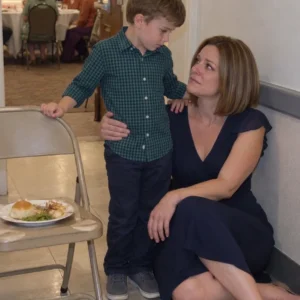
I lowered myself onto the tiled floor in my navy dress and leaned against the wall. Milo dragged the chair nearer, its metal feet squealing, then sat beside me with his plate balanced on his knees, asking whether we were at the children’s table.
“No, bud. This is just a hallway.”
“Can we still do the song?”
“We can do anything we want.”
He split his bread roll and offered me the bigger half. We ate cold beans with our fingers while guests passed toward the bathrooms, and Milo compared the noisy hand dryer to a backhoe.
My cheerful boy resurfaced briefly before Courtney’s heels clicked nearby. “It’s a regulation break,” she said. “Standard. You’re making it a scene.”
“He’s six. He’s with me now.”
“Amanda, I do this all day.”
“Not with him.”
She bent slightly, speaking past me to Milo in her measured professional tone about children getting breaks when they got loud at dinner. But he hadn’t been loud at all; he’d quietly folded a napkin.
Straightening, Courtney accused me of showing him that making scenes got results. When I asked what problem she meant, she offered a patronizing smile. I stood, retrieved the plate, and reached for Milo’s hand. As Courtney shifted out of our way, she added: “Mom agrees with me. Ask her.”
BACK TO REALITY
Back inside, Mom was dividing the cake, placing a corner piece bearing an intact buttercream rose on a plate for Hazel, Courtney’s elder daughter. For nine years I had watched Hazel receive that special piece without considering the pattern. Mom noticed us, looked at the plate I carried, then at the corridor beyond the doors. Her knife paused. I waited for her to speak, but she resumed slicing cake.
“Happy birthday, Mom,” I said. “We’re going home.”
“Drive safe, Amanda.”
At the second traffic signal, Milo asked from his booster seat, “Mom, did I do the party wrong?”
I watched the red light until I trusted my voice. “No, bud. You did the party right.”
He fell asleep before we got home, a hand resting on the napkin covering his plate. At 9:15, Nate called, and after I explained the evening, he said, “I’ll be home by morning. Don’t let anyone talk you into anything tonight.”
Afterward I lay awake, recalling an incomplete childhood scene of brown linoleum, a tray in a corridor, and tiny white socks with pink heels.
At exactly 12:07, my phone illuminated. Mom was already sobbing when I answered. “I’m sorry about tonight. I’m so sorry. I need one favor. Just one.”
An email appeared mid-conversation: Courtney had attached a consent document from her clinic, and Mom urged me to sign it, calling it only one assessment. “If he passes,” she said, “he sits with us at Thanksgiving. Right beside me. I promise.”
I stared at the attachment. “If he passes?”
“Mandy, please. She says if you don’t—”
The connection ended, and two return calls went directly to voicemail. In the kitchen, I wrote 12:07 on an envelope without opening the attachment, while Milo slept peacefully down the hall, unaware that his grandmother had just made family belonging conditional on passing his aunt’s examination.