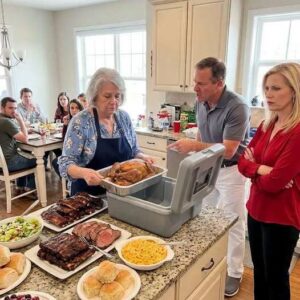
Grandma’s voice was steady and unmistakable as she stared at my father on speakerphone. “I canceled the transfer,” she told him.
Dad’s expression shifted abruptly. “You did what?”
“I’m not sending you money anymore.”
“Why on earth would you do that?”
“Because I’ve seen Claire’s notebook,” Grandma replied calmly. “The green one. The one you signed.”
Dad stared at me across the darkened porch, his complexion draining of color.
“I know what my granddaughter has paid,” she continued. “And I know the lies you told me. Good night, Martin.”
She disconnected the call, leaving only the cold November wind filling the heavy silence.
Through the storm door, I could see Mom and Tessa observing us nervously from the living room sofa.
“The mortgage transfer went through this morning,” I told Dad quietly. “One thousand six hundred fifty dollars. Exactly as promised.”
I descended the porch steps without waiting for an answer. “That’s the last one.”
I walked to my car and sat inside until my trembling knees finally steadied enough for me to drive away.
Once parked safely down the street, I pulled up a message I had been reviewing almost nightly for three weeks.
A reporter from Columbus Business Weekly had confirmed a Monday, November 30 feature on two local professionals opening an independent Grandview Heights financial planning firm.
Northline Financial Planning. Margaret Caldwell and Claire Bennett, co-founders.
Those were the congratulations my phone had been receiving the night Dad packed my boxes.
At seven o’clock on October 8, while Dad taped up my sweaters, our previously prepared business announcement had gone live online.
Former colleagues, mentors, classmates, and loyal clients had congratulated us throughout Tessa’s entire birthday dinner.
I had planned to resign from the bank at the end of October anyway, so when the corporate merger eliminated my role three weeks early with twelve weeks of severance pay, it felt like an unexpected gift.
I had kept my business venture entirely private for a reason worth exactly $6,000.
Back in 2015, at age twenty-one, I had proudly mentioned saving that money for my professional certification over dinner.
Two weeks later, Dad borrowed every dollar for Tessa’s summer dance intensive in Chicago, promising full repayment by Christmas—a promise that went unfulfilled for three years.
That painful lesson taught me that mentioning personal savings in my parents’ house meant those funds would inevitably be claimed for someone else.
Over the last four years, I quietly saved $40,000 in bonuses, invested every penny with my former supervisor Margaret, and secured a forty-percent ownership stake in our new firm.
Our inaugural official client was June Holloway, eighty-two, of Grove City, Ohio—my beloved grandmother.
After November 1, Dad took to Facebook to condemn ungrateful children who supposedly turned against their families and manipulated elderly relatives.
Aunt Joanne sent me screenshots showing forty-one sympathetic comments from oblivious cousins and church acquaintances, including one claiming I had always seemed cold—a comment Mom eagerly liked.
Instead of arguing online, I simply archived the screenshots with my other records.
Thanksgiving fell on November 26, just one day after Tessa’s first unpaid Ford Bronco installment became overdue.
Her frantic text messages started early that morning, complaining about a forty-dollar late fee and blaming me for punishing her.
That evening, Dad emailed a “temporary family financing proposal” asking me to co-sign a $20,000 personal loan to stabilize their household cash flow.
My reply consisted of a single word: No.
Tessa phoned on Saturday, furious rather than tearful, accusing me of destroying the family over a bedroom that wasn’t even mine.
“Dad already arranged for the house to go to me when he and Mom are gone,” she sneered before hanging up. “So technically, you’ve been living in my future house.”
Checking the county recorder’s database again, I uncovered a notarized transfer-on-death designation signed just nine days after the August 2022 refinancing.
The sole beneficiary listed on the property was Tessa Bennett—I wasn’t even named as an alternate, despite Mom repeatedly promising me for years that the house would someday be mine.
When I met Mom at a local diner on Sunday and placed the document beside her coffee, she dabbed her watery eyes and confessed she had promised Tessa after her premature birth that she would never let her fall.
“I let you be the strong one,” Mom whispered. “And if I had to make the choice again, I’d probably do the same.”
I folded the paper and stood up. “Then you need to do it with your own money, Mom.”
On Monday, November 30, the Columbus Business Weekly article hit newsstands, featuring a photograph of Margaret and me beneath our brass-compass sign and inviting readers to our December 5 grand opening.
Dad learned the truth the next morning when he checked his bank account, found no mortgage deposit, and Mom handed him the newspaper article over breakfast.
He called nine times before noon, leaving a ragged voicemail demanding to know how I could let my mother struggle while sitting on business capital.
To protect his spotless credit reputation, Aunt Joanne later told me Dad had to raid his pickup truck replacement fund on December 15 to pay the full $2,184 mortgage himself.
Our grand opening on Saturday, December 5, drew forty guests into our sunlit brick office, with Grandma sitting proudly in the front row in her finest navy outfit and pearls, holding heavy brass ribbon-cutting scissors across her lap.
At 3:52 p.m., the entrance bell chimed, and Mom marched into the center of the room with Tessa trailing behind in dark sunglasses.
“So this is where all the money went,” Mom announced loudly, silencing the entire gathering. “People should know who they’re trusting with their savings.”
She pointed directly at me, claiming I had lived under their roof for thirty-two years only to abandon them and turn an elderly woman against her own family.
Tessa pushed her sunglasses up onto her head. “She owes us. That house belongs to our family.”
I remained completely calm, refusing to turn our celebration into a screaming match.
Suddenly, a chair scraped against the floor as Grandma stood up slowly, leaning on her chair with one hand while holding the brass scissors in the other.
“Elaine,” Grandma said clearly.
Mom spun around in shock. “Mom? What are you doing here? You shouldn’t be out this late.”
“I didn’t drive,” Grandma replied firmly. “Claire brought me.”
Reaching into her handbag, Grandma pulled out my green accounting notebook, opened it to the final page, and raised it toward the silent room.
“Your husband wrote something in this book,” she said, reading Dad’s handwriting aloud. “‘Paid in full. Don’t expect a thank-you.’”
Mom’s face paled as Grandma angled the pages toward the guests.
“Above that sentence is a record of $215,850 my granddaughter contributed to that house, starting when she was seventeen years old at a grocery store,” Grandma declared.
“And I have fifty months of four-hundred-dollar payments in my own check registers—money I sent because Martin lied and told me Claire had stopped supporting you.”
Mom stammered helplessly, “Mom, this isn’t—”
“I’m not finished, Elaine,” Grandma interrupted without raising her voice. “Now I’m going to ask you and Tessa to leave. Right now. These people came to celebrate something good.”
Frozen under the stares of forty strangers, Tessa quickly grabbed Mom’s sleeve and guided her out the front door.
Grandma sat back down, tucked the notebook away, and looked cheerfully at the Chamber of Commerce representative. “Well, are we going to cut this ribbon or not?”
Laughter broke the tension, and with one decisive snip of the brass scissors, Northline Financial Planning officially opened to thunderous applause.
By January, reality caught up with my family swiftly: Tessa’s white Bronco was repossessed from the driveway at four in the morning after she ignored months of overdue notices.
When she called me at 7:15 a.m. screaming about the humiliation of riding the city bus and demanding to know who would pay for her car, I reminded her calmly of the question she asked at her birthday dinner.
“Nobody, Tessa,” I told her evenly. “Nobody else is supposed to pay for your car.”
Two days later, my parents arrived at our office looking worn and aged, offering to amend their will so Tessa and I would split the house equally—if I resumed paying $1,650 a month starting in February.
Instead of arguing, I opened my green notebook directly beneath Dad’s old signature and wrote: Account closed. No further payments. No loans or co-signing. Claire Bennett.
When Dad murmured that I didn’t understand what it felt like to watch a father lose everything on the courthouse steps, I met his eyes quietly. “I watched my father lose his house too.”
Dad froze, seeing me as a person rather than a paycheck for the very first time before turning away with Mom.
There was one final test the following Saturday when Mom called Grandma crying for an hour, begging her to surrender her $41,000 burial annuity to save their house.
I drove Grandma straight to Hilliard, where she stood on the front porch and handed Mom a faded cotton diner apron with Elaine embroidered in red—the one Mom wore at fifteen when she dropped out of high school to save the family diner.
“I made you carry burdens that never should’ve belonged to a fifteen-year-old girl, and I’ve been sorry every day since,” Grandma told her gently.
“But you took that same weight and placed it on Claire when she was seventeen. I won’t help you continue doing that, and I won’t give you my retirement savings.”
Turning back to me on the steps, Grandma touched my cheek with trembling fingers. “Thank you, Clairie, for all those years you kept that family going. Nobody ever properly thanked you, did they?”
When I shook my head through tears, she whispered softly, “Well, somebody has now.”
Seven months later, life has settled into honest, sustainable boundaries for everyone.
To cover their $2,184 mortgage, Dad works overtime at the warehouse and rented out my old pink bedroom to a traveling nurse and the basement to a night-shift worker—packing Tessa’s things into the exact same cardboard boxes he once used for mine.
Tessa moved back into her childhood room and rides the Number 10 bus to rent a booth at a local salon, slowly learning to stand on her own two feet.
Meanwhile, Northline Financial Planning has grown to sixty-one loyal clients, with Grandma’s brass scissors framed proudly behind our reception desk.
Best of all, Grandma finally used her own savings for both cataract surgeries, restoring her crystal-clear eyesight so she could drive under the glowing streetlights of Broad Street once again.
Sitting beside her in her old Buick as lilacs bloomed along the avenue, I finally realized that loving your family never means funding every choice they make—and true home is the peace you build behind your own front door.