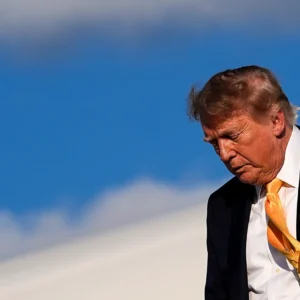
A dramatic warning from Russia has intensified global anxiety after former President Donald Trump renewed rhetoric about U.S. control over Greenland, prompting sharp reactions from NATO allies and raising concerns about escalating tensions in the Arctic.
Russian officials have reportedly warned that aggressive moves toward asserting control over Greenland could trigger catastrophic consequences, with one senior lawmaker characterizing such a scenario as potentially marking “the beginning of the end of the world.” While such language reflects heightened political rhetoric, analysts say it underscores how sensitive Arctic geopolitics have become.
At the center of the controversy is Trump’s long-standing interest in Greenland, the vast Arctic territory that is part of the Kingdom of Denmark but maintains significant self-governance. Trump first floated the idea of purchasing Greenland during his previous presidency, a suggestion that was firmly rejected by Danish and Greenlandic leaders at the time.
In recent remarks, Trump has again framed Greenland as strategically vital to U.S. national security, particularly as Arctic shipping lanes expand and global powers compete for influence in the region.Why Greenland Matters Strategically
Greenland occupies a crucial geographic position between North America and Europe. It sits along key Arctic air and sea routes and hosts the Pituffik Space Base (formerly Thule Air Base), a long-standing U.S. military installation that plays a role in missile detection and early warning systems.
As climate change reduces Arctic sea ice, new shipping routes and resource access points are emerging. This has heightened interest from major powers, including the United States, Russia, and China.
The Arctic is increasingly viewed not just as a remote wilderness but as a strategic frontier.
NATO Concerns and Allied Response
Denmark and Greenland’s leadership have reiterated that the island is not for sale. Danish officials have emphasized sovereignty and the importance of alliance coordination within NATO, cautioning against unilateral action that could strain transatlantic relationships.
Some NATO partners have reportedly expressed concern that aggressive rhetoric about Greenland could create friction within the alliance, particularly at a time when unity remains central to European security.
Military analysts note that Arctic deployments—whether defensive exercises or troop movements—can be misinterpreted during periods of tension. In regions where multiple nuclear-armed states operate in close proximity, even routine maneuvers can be viewed through a lens of suspicion.
Russia’s Reaction
Russian officials have portrayed the renewed Greenland rhetoric as destabilizing. Moscow has long viewed NATO expansion and missile defense systems near its borders as threats to strategic balance.
The Russian senator’s “end of the world” remark appears to reference fears that expanded U.S. missile defense infrastructure in the Arctic could undermine Russia’s nuclear deterrent capabilities. Russian defense doctrine historically treats strategic missile parity as foundational to global stability.
When officials use extreme language, analysts caution that it often serves both domestic audiences and international signaling. Such statements may aim to deter adversaries from escalating or to reinforce internal narratives about external threats.
The “Golden Dome” Concept
Reports have referenced what some describe as a “Golden Dome” vision—an expanded missile defense shield in northern regions. Missile defense systems have long been controversial in nuclear diplomacy. Supporters argue they protect against rogue state threats; critics contend they destabilize deterrence by creating perceived first-strike advantages.
The delicate equilibrium that has prevented nuclear war since World War II relies heavily on mutually assured destruction—the understanding that no side can eliminate the other’s retaliatory capacity. If one nation believes that balance is shifting, tensions rise.
Arctic militarization has grown in recent years, with Russia expanding its northern bases and NATO increasing exercises in the region. While these moves are often described as defensive, each side interprets the other’s actions cautiously.
Risks of Miscalculation
Security experts frequently warn that the greatest danger in nuclear-armed confrontations is not necessarily deliberate war but miscalculation.
The Arctic presents unique challenges:
Harsh weather and limited infrastructure
Remote military installations
Increased air and naval patrols
Overlapping territorial claims
In such an environment, misunderstandings can escalate rapidly if communication channels are strained.
Diplomatic analysts emphasize that maintaining open lines of communication between major powers remains critical, especially during periods of heightened rhetoric.
The Political Dimension
Trump’s renewed comments about Greenland appear tied to broader national security framing. Supporters argue that strengthening U.S. Arctic presence enhances strategic positioning amid rising competition from Russia and China.
Critics counter that rhetoric suggesting ownership or unilateral control risks alienating allies and escalating tensions unnecessarily.
The situation also illustrates how statements made in political contexts can reverberate globally, influencing military posturing and diplomatic messaging.
What Happens Next?
At present, no formal proposal or policy change has been enacted regarding Greenland’s status. Danish and Greenlandic authorities continue to assert sovereignty, and the United States maintains an established but longstanding military presence through existing agreements.
The Arctic Council and NATO frameworks provide avenues for dialogue, though geopolitical rivalry has increasingly complicated cooperative efforts.
While extreme language about “the end of the world” captures headlines, experts note that deterrence systems, alliance structures, and diplomatic channels remain intact.
Still, the episode highlights how quickly Arctic geopolitics can shift from theoretical debate to high-stakes confrontation.
A Region Growing in Importance
As climate patterns change and global powers compete for strategic advantage, the Arctic is no longer peripheral to world affairs. It has become a central arena for military planning, energy exploration, and diplomatic maneuvering.
Whether Greenland becomes a flashpoint or remains a managed point of tension will depend largely on how leaders balance strategic ambition with alliance coordination and risk management.
For now, the rhetoric alone has been enough to draw global attention—reminding the world how fragile strategic equilibrium can feel when powerful nations exchange warnings in a rapidly evolving frontier.