I have been a patrol officer in Dayton, Ohio, for sixteen years, and I can tell you the exact minute my radio changed my entire week.
It was 2:07 on a rainy Monday morning while I was parked behind a closed gas station on Wayne Avenue, finishing a cup of coffee that had gone cold an hour earlier.
Victor, our overnight dispatcher who normally speaks with the calm steadiness of a man reading the farm report, came over the line with an unmistakable catch in his voice, directing me to a house on Linden Street where a seven-year-old girl was completely alone.
Before I could even pull out of the lot, Victor played the recording of the emergency call, and a small, careful voice filled my cruiser: “Daddy said he’d be back in thirty minutes. He said everything he does is because he loves me. It’s been four days.”
Arriving at the small white house on Linden Street in four minutes, I knocked gently on the front door and heard small footsteps approach before a voice asked me to hold my badge up to the window because her daddy had taught her to always check first.
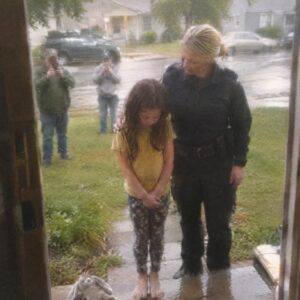
When the lock clicked open, seven-year-old Poppy Sorrell stood there in a yellow t-shirt and patterned leggings with a grey stuffed rabbit named Pickle tucked under her arm like a football, calmly explaining that Pickle was scared of the thunder even though she wasn’t.
A paramedic named Rosalind arrived moments later, examined Poppy on the living room rug, and confirmed that the little girl was completely unharmed and well-fed—having eaten cereal, peanut butter bread, and cold soup straight from the can because she wasn’t allowed to touch the stove.
Sitting down on the floor so I wouldn’t tower over her, I listened as Poppy explained that the thunder had woken her up, prompting her to count the tally marks taped beside the phone and decide that four sleeps was simply too long to wait before calling for help.
Having walked through countless neglected homes over sixteen years on the force, I knew immediately that this house told a very different story: clean plates sat neatly in the dish rack, children’s drawings were taped at eye level down the hallway, and a doctor’s reminder card for an asthma checkup was pinned beneath a ladybug magnet on the refrigerator.
On the kitchen counter rested a grocery list written in a man’s blocky handwriting—listing milk, eggs, bread, bananas, and fish crackers, with a single word underlined twice at the very top: Inhaler.
Climbing onto a kitchen chair and setting Pickle on the table facing me so he could listen too, Poppy explained that on Thursday evening her asthma puffer had been nearly empty, and when her father’s pickup truck only made a clicking noise in the driveway, he decided to walk quickly to the pharmacy and the store.
Before stepping out into the rain, he had instructed her to lock the door and never open it for anyone, kissed the top of her head, and promised he would return in thirty minutes—adding his usual phrase, “Everything I do is because I love you, Pop.”
Pointing to a framed photograph of a smiling woman in a sun hat by the light switch, Poppy quietly shared that her mother had passed away from an illness when she was four, leaving just her, her thirty-four-year-old roofer father Emmett Sorrell, and Pickle.
By sunrise, a caseworker named Lorraine had arrived and Poppy’s aunt Colleen was racing down from Lexington, while word of the two patrol cars and ambulance had drawn half the neighborhood onto the wet front lawn.
Standing front and center in a bright yellow raincoat with her arms folded was a longtime neighbor named Bernice Tuttle, who announced loudly to the gathering crowd—and the men filming on their phones—that she had always known Emmett would eventually walk out and abandon his child, pointing to his parked pickup truck as proof that he hadn’t driven anywhere.
Seeing Poppy look down at her bare feet in quiet shame, I rested a reassuring hand on her shoulder and decided to walk the exact six-block route Emmett always took to the corner pharmacy, knowing full well that a father who underlines his daughter’s medicine twice and leaves all his work tools in his truck does not simply vanish.
Eleven minutes later, I reached the corner pharmacy twenty minutes before opening, where a tall, soft-spoken pharmacist named Mr. Abernathy recognized Emmett’s photo immediately and confirmed that he had hurried in at 6:40 p.m. on Thursday to pick up Poppy’s inhaler because his truck wouldn’t start.
Before I could leave, Mr. Abernathy bent down behind the counter and placed a ring of keys in front of me—a truck key, two house keys, and a plastic tag holding Poppy’s school picture—explaining that Emmett had accidentally left them behind in his rush to tuck the medicine bag inside his jacket out of the rain and hurry straight toward home.