The forensic document examiner who reviewed both disputed signatures determined that neither was consistent with my father’s authentic handwriting across reference samples, noting that the February signature showed distinct characteristics of an attempt to replicate a known signature by someone familiar with its general appearance but unable to accurately reproduce its specific features—a clinical confirmation of what I already suspected, which was that my brother Gary had seen Dad’s signature hundreds of times yet failed to replicate it correctly.
Sandra’s notary commission was promptly revoked in June, and she chose to cooperate with the expanding investigation in ways that spared her from carrying the full legal brunt of her husband’s actions, a sobering realization of how fragile marriages become when buried beneath fabricated debts.
By July, Gary was formally charged with two counts of forgery and one count of financial exploitation of a vulnerable adult—a critical charge directly tied to the February document and supported by definitive medical records addressing my father’s diminished cognitive and physical capacity following his stroke.
Although the forty-five-thousand-dollar line of credit had already been drawn down to thirty-one thousand before the bank placed its vital administrative hold, the ongoing civil proceedings focused aggressively on recovering those stolen funds and restoring integrity to my father’s estate.
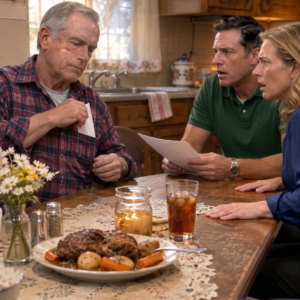
Yet, what weighed heaviest on my soul throughout those four grueling months of legal battles wasn’t the court paperwork or the bank filings, but the memory of that Sunday in February at Dad’s kitchen table when I helped him write his property tax check while his hands shook and his face bore an expression I had mistakenly brushed off as mere embarrassment.
I tormented myself wondering whether he secretly understood the financial trap being closed around him during those vulnerable weeks, or if he was simply too exhausted and cognitively overwhelmed to resist his son’s betrayal.
He passed away in March still harboring the quiet, steadfast belief that his children were being cared for and that his decades-long mission to rescue Gary was a burden he carried out of enduring love—a heartbreaking truth that remains heavy to bear.
Even now, my father’s cracked-corner Samsung cell phone sits charged on the kitchen counter of the house on Clearwater Road, continuing to receive my steady guardianship long after the pharmacy and dentist’s office stopped calling.
That old phone, kept alive by a daughter’s refusal to instantly sever the ties of a life cut short, became the improbable instrument of justice, proving that sometimes the sideways grace of redemption arrives in the quietest, most unexpected ways.