The following morning, I contacted Washington Elementary School.
The cafeteria manager, Mrs. Fogle, had worked there for more than thirty years.
I explained that I wanted to contribute toward outstanding school lunch balances.
She thanked me warmly and checked the official records.
Then she gave me a specific number that stopped me in my tracks.
“Twenty-three second-grade students currently have unpaid lunch balances,” she said.
I was genuinely surprised. Twenty-three children.
“How much do they owe altogether?” I asked.
I heard her typing on the keyboard.
“Nine hundred eight dollars and forty cents,” she replied.
I sat down heavily in my chair.
$908.40.
My final paycheck from Dale was $915.
The difference was a mere six dollars and sixty cents.
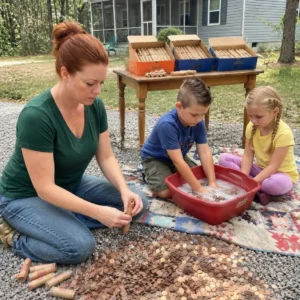
I looked outside toward the enormous pile of oily pennies resting on our grass.
Then I made my final decision.
“Mrs. Fogle, I’d like to cover the entire amount,” I said.
She went completely quiet on the other end of the line.
“All of it?” she whispered.
“Yes, all of it.”
Then I explained how I had received the money.
The buckets. The motor oil. The driveway.
And the days my children and I were spending cleaning every single coin.
When I finished my story, she whispered, “Oh, honey.”
Over the following days, we continued working tirelessly.
My husband Jake joined us whenever he returned home from hauling logs.
The children helped whenever they could, while Jake and I handled the heavier washing.
Eventually, every single penny had been thoroughly cleaned and rolled.
We packed the coins neatly into seventy-four shoeboxes.
The next morning, Jake helped transport them to the school.
Mrs. Fogle and the principal were waiting by the entrance.
When they saw the heavy boxes stacked high, they stared in absolute disbelief.
Noah held one final roll in his small hand.
Lily had wrapped it herself.
It was a little crooked, with uneven paper edges around the cylinder.
Noah walked toward Mrs. Fogle and held it out proudly.
“My sister made this one,” he explained. “It’s for the kids who don’t have enough lunch money.”
Mrs. Fogle took it carefully, as if it were made of glass.
Then she sat down at her desk.
Her eyes filled with sudden tears.
For thirty-one years, she’d watched children struggle with unpaid lunch accounts.
Sometimes she’d even contributed money straight from her own pocket.
Now, because of a family she’d barely known, every negative second-grade balance would be cleared.
She looked at Noah with profound emotion.
“Sweetheart, because of your family, those twenty-three children won’t have to worry about their lunch balances today.”
Later that morning, the school published a heartfelt thank-you message on Facebook.
It described how a local mother and her children had cleaned and rolled 91,500 pennies to pay off school lunch debt.
The message didn’t mention my former employer by name.
But Merrill was a tight-knit small town where everyone knew everyone.
The story of Dale dumping oily pennies in my driveway had already circulated among former coworkers.
Within hours, the post received hundreds of shares, and then thousands.
People expressed intense anger over how I’d been treated and deep admiration for what the money had become.
I didn’t join the online discussion.
I didn’t want revenge or drama.
I simply wanted to settle into my new job and enjoy a normal life with my family.
But the following morning, the school called me again.
It was Mrs. Fogle.
“Becky, could you come here to the office?” she asked urgently.
“Is something wrong with the pennies?” I asked, my heart skipping a beat.
“No. Everything is fine with the money.”
She hesitated before adding, “Dale Heckert is in my office right now.”
I froze completely in the middle of my kitchen.
“What does he want?”
“He says he needs to speak with you.”
“Why?”
Her voice softened gently.
“Becky, he’s crying.”
When I arrived at the school office, Dale was sitting in a small plastic chair.
He wore his usual gray work shirt and heavy work boots.
But he looked completely different from the man who’d dumped those pennies outside my home.
His shoulders were hunched in defeat.
His eyes were red and swollen.
On his lap sat an old rusted coffee can.
He stood up immediately when he saw me walk through the door.
“Becky,” he choked out.
I remained cautiously near the doorway.
“What do you want, Dale?”
He placed the old coffee can onto the front counter.
“I need to give you something,” he said.
He slowly removed the plastic lid.
Inside were neat bundles of fresh cash.
“Four thousand three hundred dollars,” he stated softly.
I stared at him in utter shock.
“What’s that for?”
“The rest of the school. Every single grade. I asked Mrs. Fogle how much total lunch debt was outstanding.”
I looked toward Mrs. Fogle.
She nodded confirmation.
Then I turned back to Dale.
“Why are you doing this?”
He lowered his head, staring at the floor.
For several long moments, nobody spoke in the small office.
Finally, he whispered, “Because I know what it’s like to be the kid who gets the cheese sandwich.”
Mrs. Fogle gently stepped in to explain.
When Dale was young, his family had struggled tremendously with money.
His father operated the repair shop, but household finances were unpredictable.
For years, Dale had arrived at school without enough money for lunch.
He received the exact same basic cheese sandwich that Noah had described.
Other children had mocked him mercilessly.
They called him “Cheese.”
The painful nickname had followed him for decades.
“I hated that name,” Dale admitted, his voice cracking. “लेकिन I never told anyone.”
He paused to swallow hard.
“In fifth grade, my lunch debt became so large the school was going to contact my father.”
Mrs. Fogle looked at him with sympathetic eyes.
“My mother worked in the cafeteria back then,” she explained. “Her name was Irene Bauer.”
She smiled sadly.
“Она paid Dale’s lunch balance herself. Then she kept helping him quietly every month.”
Dale wiped tears from his cheek with a rough hand.
“I didn’t find out until years later, after she died.”
His voice broke entirely.
“Она helped me when nobody else would.”
I looked at the old coffee can on the counter.
For the first time, I understood why the school’s Facebook post had affected him so deeply.
Dale continued explaining.
“When I saw what you did with those pennies, I remembered being that little boy.”
He looked directly into my eyes.
“I wanted to humiliate you, Becky. I was angry because you were leaving for a better job.”
His eyes filled with fresh tears.
“You were the best employee I ever had, and I treated you terribly.”
He swallowed hard.
“I’m sorry. For the pennies. For the oil. For the way I behaved during your final two weeks.”
I stood quietly, absorbing his words.
Then he added, “And I’m sorry I never thanked you for six years of hard work.”
While we were talking, Noah appeared quietly at the office doorway.
He looked curiously at Dale.
“Mr. Heckert?” he asked.
Dale turned around quickly.
“Hello, Noah.”
Noah noticed the can of money on the counter.
“Is that for the kids who need lunch?”
Dale nodded slowly.
“Yes, Noah. For the whole school.”
My son considered that information carefully.
Then he asked, “Did you ever get the cheese sandwich when you were little?”
Dale looked startled by the question.
Finally, he nodded.
“Yes. For three whole years.”
Noah was quiet for a moment.
“Did kids make fun of you?”
“Yes, they did.”
“Did anybody tell them to stop?”
Dale shook his head slowly.
“No, nobody did.”
My son reached deep into his pants pocket.
He pulled out a single shiny penny.
He’d secretly kept it after we finished rolling all the other thousands of coins.
He held it out toward Dale on his small palm.
“This was one of your pennies,” Noah explained. “We cleaned it up real good.”
Dale looked thoroughly confused.
“Why are you giving it back to me?”
“Because you apologized to my mom.”
Noah paused, looking up at the grown man.
“And because nobody helped you when those kids were mean to you.”
He extended his hand further.
“So I want to say I’m sorry they treated you that way.”
Dale slowly accepted the tiny penny.
He stared at it in his large palm.
Then he sat down heavily in the plastic chair and covered his face with his hands, crying openly.