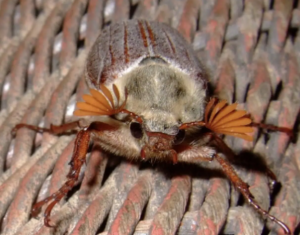
The insect in the photograph is a cockchafer, also widely known as the May bug or May beetle. Its scientific name is Melolontha melolontha. It is a large, stout beetle belonging to the scarab family, and it is one of the most familiar large beetles in many parts of Europe. Adults typically measure between 2.5 and 3 centimeters in length. Their wing covers are a warm reddish-brown, while the head and thorax are darker. The most distinctive feature is the pair of fan-shaped antennae. In males the fans are especially large and conspicuous; when the beetle is active they open like small combs. The body is covered in fine, pale hairs that can give it a slightly dusty or frosted appearance under certain light. These details match the creature shown in the image and explain why someone seeing one for the first time at a window might describe it as huge and unlike anything they have encountered before.
Cockchafers appear in late spring, most commonly from late April through June, with peak activity in May. This timing is the origin of the common name “May bug.” During the day the adults rest on leaves or in vegetation. At dusk and after dark they take flight. Their flight is heavy and noisy; the wings produce a low, continuous buzzing that can be heard from several meters away. They are strongly attracted to artificial light. Streetlights, porch lights, and kitchen windows left open or brightly lit often draw them in. Once they reach a window they may strike the glass repeatedly as they try to reach the light source. The impacts are loud enough to startle someone inside, especially at night when the house is quiet. The combination of sudden noise, a large dark shape against the glass, and the unfamiliar appearance of the open antennae is what leads many people to feel alarmed.
Despite their size and dramatic arrival, adult cockchafers are harmless to humans. They do not bite, sting, or carry diseases that affect people. Their mouthparts are adapted for chewing soft plant material, not for piercing skin. If one lands on a person it may crawl slowly, but it will not attack. The sensation of a large beetle moving across clothing or skin can still be unpleasant simply because of its size and the tickle of its legs, yet there is no venom or defensive chemical involved. When one enters a house it is almost always an accidental visitor drawn by light rather than a deliberate intruder. Once the light is turned off or the beetle is moved outside, it usually does not return immediately.
The life cycle of the cockchafer is long and mostly hidden underground. Females lay eggs in soil during early summer. The larvae, often called white grubs, hatch and spend the next three to four years feeding on the roots of grasses, garden plants, and young trees. A fully grown larva is a thick, C-shaped white grub with a brown head and strong jaws. These grubs can cause noticeable damage in lawns, vegetable beds, and orchards when their numbers are high. Patches of turf may turn brown and lift easily because the roots have been eaten away. In agricultural areas, heavy infestations have historically reduced yields of cereals and other crops. After several years the larva pupates in the soil and emerges as an adult the following spring. The adult stage itself is short, lasting only a few weeks. During that time the beetles feed on the leaves of deciduous trees, especially oak, beech, and fruit trees, and they mate. The males’ large antennae help them locate females by detecting pheromones.
Because the adult flight period is brief and concentrated, local populations can seem to appear suddenly. In some years, and in certain regions, the numbers are high enough that swarms are noticed. In other years only scattered individuals turn up at lights. Weather and soil conditions during the long larval period influence how many adults emerge in any given spring. The beetles are native across much of Europe and are also found in parts of western Asia. They are absent from many northern areas and from regions where the soil or climate does not suit the larvae. In places where they occur, older residents often remember them as a regular feature of late spring evenings.
Handling a cockchafer that has entered a home is straightforward. The simplest method is to place a glass or jar over the beetle, slide a piece of cardboard underneath, and carry it outside. Releasing it away from bright lights reduces the chance it will fly straight back. Closing windows or fitting fine screens during the peak weeks of May limits entries. Outdoor lighting can be reduced or switched to warmer, less attractive bulbs. These steps address the nuisance without harming the insect. Because the adults live only a short time and do not reproduce indoors, there is no risk of an infestation developing inside a house.
The larvae are a different matter when they damage gardens or lawns. Gardeners who notice wilting plants or loose turf in spring or early summer sometimes find white grubs when they dig. Cultural controls include encouraging natural predators such as birds, keeping lawns healthy so they can tolerate some root feeding, and, in severe cases, using biological products that contain nematodes parasitic to the grubs. Chemical treatments exist but are less commonly recommended for home gardens because of their broader effects. Most years the damage remains minor and localized.
Historically, cockchafers were more than a curiosity. In parts of Europe they were once so abundant that they were collected in large numbers. Some rural communities used them as food for poultry or even, in times of scarcity, prepared the adults themselves. Their sudden appearances were noted in local records and folklore. Today they are less numerous in many agricultural landscapes because of changes in land use and pest management, yet they remain common enough in parks, gardens, and woodland edges to surprise people who have never seen one up close.
The reaction described in the social-media post is therefore understandable. A large, unfamiliar beetle striking a kitchen window at night, with its antennae spread and its body filling much of the view, can look alarming. The buzzing flight and the repeated impacts add to the surprise. Once identified, however, the insect fits a well-known pattern. It is a seasonal visitor whose entire adult life is spent feeding, mating, and flying toward light for a few weeks each spring. It poses no threat to people, requires no special treatment beyond gentle removal, and will disappear again until the next generation emerges years later. For anyone who finds one on a window or inside a room, the practical response is the same: trap it carefully, release it outdoors, and turn off unnecessary lights. The cockchafer will continue its brief adult life among the trees, and the house will return to quiet.