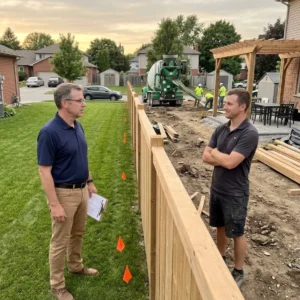
Tyler built the fence on a Saturday, and at first, I barely noticed. That is the part people never believe when I tell this story. I did not storm outside the second the first post went into the ground; I was inside making coffee, half-watching the morning news, when I heard the sharp kick of an air compressor.
I glanced through the kitchen window. Two workers in matching polo shirts were unloading cedar fence panels from a trailer parked crooked across Tyler’s driveway. Tyler stood near the edge of what I still believed was my yard, arms crossed, nodding as one of the workers explained something to him. He looked like a man supervising the construction of his own private kingdom.
My first thought was simple: that’s a big project for a Saturday. My second thought was that it was none of my business. If Tyler wanted a fence on his property, that was his choice. That is the strange thing about boundaries—most of the time, you never think about them. Not until someone moves one.
By the time the workers left that evening, something about the fence looked deeply wrong. I stared at it from my kitchen window while the last sunlight stretched across the lawn. The fence seemed entirely too close to my house. I told myself I was imagining things; new fences always looked strange, and maybe the shadows made the yard appear smaller. I decided to check again in the morning.
MEASURING THE ENCROACHMENT
In daylight, it looked even worse. I went into the garage, grabbed a heavy tape measure, and walked the length of the new fence. By the third measurement, I stopped pretending I was merely curious.
The fence was not off by a few inches. It appeared to be nearly eight feet inside my property, running almost the entire depth of the yard. That strip of grass had been mine for more than a decade. I had mowed it, edged it, fertilized it, and maintained it every single summer since I bought the house.
A little after nine that morning, I found Tyler sitting on his new deck drinking coffee.
“Morning,” I said, keeping my voice calm. “Fence looks good. Your contractor works fast.”
“He’s efficient,” Tyler replied. “Wanted it finished before the pool guys start digging.”
That caught my attention immediately. “About that,” I said. “I think the fence might be farther onto my side than the old property line.”
Tyler did not look surprised. That bothered me more than anything else—there was no confusion in his face, no concern, nothing you would expect from someone who had accidentally built eight feet onto his neighbor’s property.
“I don’t think so,” he said, shrugging. “But even if it is, moving it now would cost a fortune. The contractor already packed up.”
“I haven’t confirmed anything yet,” I said. “I just think we should check before you go any further with the pool.”
He smiled that familiar, irritating smile—the kind someone gives you when they believe the conversation is already over before it starts. “You’ve got plenty of yard, Jason,” he said dismissively. “I don’t think eight feet is going to change your life.”
THE SURVEYOR’S VERDICT
For a moment, the conflict-avoidant part of me almost let him have it. I hated arguments; I was the man who would eat the wrong restaurant order rather than send it back unless it was completely inedible. But Tyler hadn’t asked. He had simply taken, and then explained to me that I had enough property already. That changed everything.
“I’m going to have the property surveyed,” I told him. “Just to make sure.”
For the first time, his smile flickered. “Sure,” he said. “Do whatever you need to do.”
That afternoon, I called Carl Whitfield, a licensed surveyor with a reputation for being almost painfully meticulous. It took him ten days to come out, and during those ten days, Tyler kept building. His contractors dug footings for a pergola, pavers were delivered, landscapers planted ornamental grasses, and heavy excavation equipment for the swimming pool arrived. Every day, more money and concrete went into land I was increasingly certain belonged to me.
When Carl finally arrived, he checked the recorded plat, cross-referenced county monument records, and walked the boundary twice. By early afternoon, he began driving orange survey flags into the ground.
The result was unmistakable. Tyler’s fence was nearly eight feet over the legal boundary.
Carl pointed toward the line: “You were right to call me. This isn’t a few inches. He has structures and landscaping sitting almost entirely on your parcel.”
I stared at the orange flags. I did not feel victorious yet, but I felt completely clear. Until that moment, this had been a disagreement between neighbors. Now it was documented, signed, stamped, and recorded fact. Tyler could smile all he wanted, but the boundary was not going to move with him…