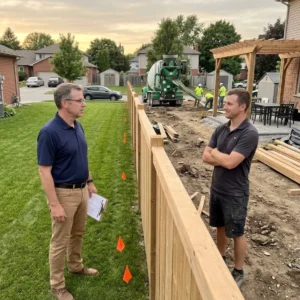
The mediator, retired Judge Ellen Price, folded her hands and looked directly at Tyler: “Mr. Bennett, let me make sure I understand. You obtained a permit showing one fence location. You instructed your contractor to shift that fence approximately eight feet. Your neighbor later provided a certified survey establishing that the fence crossed onto his parcel, and you still declined to relocate it.”
Tyler shifted uncomfortably in his chair: “I believed the usable boundary was different from the legal boundary.”
Judge Price stared at him coldly: “That sentence is not helping you in the slightest.”
It became obvious during the session that Ashley, Tyler’s wife, had not known the full extent of what he had done—the altered permit, the contractor’s secret note, the exact boundary lines, and the intentional timing of the construction. He had apparently lied to her by claiming the county was harassing them because of neighborhood connections. The truth was much simpler: county documents did not care how confidently Tyler told his version of the story.
THE COURT DECIDES
Two weeks later, we went before a superior court judge. It was nothing like television dramas; there were no cinematic speeches or surprise witnesses, just hard documents, certified surveys, original permits, email exchanges, photographs, and the contractor’s handwritten note.
Judge Harold Denny examined everything meticulously before turning his gaze to Tyler: “Why did you continue construction after receiving the certified survey?”
Tyler stammered that he believed the survey was somehow disputed. The judge asked whether Tyler had hired his own independent surveyor, filed a formal boundary challenge, or possessed any deed, easement, or title document placing the boundary where his fence stood. To every question, Tyler answered: “No.”
Then Judge Denny asked the question that utterly destroyed what remained of his defense: “Mr. Bennett, on what legal basis did you continue preventing Mr. Miller from accessing property identified by the recorded survey as belonging to him?”
Tyler looked frantically toward his attorney, but Martin could not answer for him.
“There had been a fence there before,” Tyler finally lied.
That statement was entirely false, as I had years of continuous photographic evidence showing open grass. Judge Denny issued his definitive ruling immediately: the surveyed legal boundary was fully confirmed, and Tyler was ordered to remove the encroaching fence and all associated structures within forty-five days, while being strictly prohibited from interfering with my access to the land.
DISMANTLING THE ILLUSION
Over the next month, Tyler’s expensive backyard project was slowly and painfully dismantled. Pool construction stopped dead in its tracks, leaving rainwater to collect in the half-dug hole. Workers removed the custom pergola board by board. Three young Japanese maple trees that Ashley had planted were carefully transplanted, and the decorative stone edging was pulled up.
Then the original fence contractor returned to take down the cedar panels. Beneath the mulch, one of Carl’s old orange survey flags was discovered, faded from months of sun. Carl came back to verify the corrected fence location, picked up the flag, and drove it firmly back into the ground right where it had always belonged.
When the final panel went up six inches inside Tyler’s legal property line, my yard suddenly looked enormous. Eight feet does not sound like much on paper, not until someone takes it away from you.
MAKING THE LAND WORTH DEFENDING
My daughter, Emma, came over that weekend. She stood near the restored boundary, hands on her hips: “So this is the famous war zone?”
“No war,” I replied. “Just property law.”
At first, I planned to simply restore the lawn and forget the whole ordeal. Then I remembered my father, who used to grow enormous blueberry bushes along his fence line. Every July, Emma and I would visit him, eating berries until our fingers and lips were stained purple. My father had passed away years ago, and I had always promised myself I would plant my own bushes someday.
So Emma and I spent a Saturday turning the reclaimed strip into a living garden. We planted six blueberry bushes, hydrangeas along the fence, and a small red maple near the corner. I deliberately chose not to build anything spiteful—no giant wall, no ugly shed, and no punishment designed to torment Tyler. I simply wanted the property to become something alive and worth defending.
By late summer, Tyler’s pool project resumed with a drastically smaller design, forcing him to pay massive redesign and delay costs. His mistake had become devastatingly expensive because he stubbornly kept making it worse. But that wasn’t my victory. My victory was a fence in the correct place, a clean title, a recorded boundary, and a garden growing on land that nobody could ever claim again.
THE APOLOGY A YEAR LATE
Almost a year after the dispute began, Tyler knocked on my door. He looked tired and older: “Ashley and I are selling the house. My agent says we have to legally disclose the boundary dispute, and buyers keep asking about it.”
“That’s what disclosures are for,” I said calmly.
Tyler gave a bitter laugh: “You really got everything you wanted.”
“No,” I replied.
He looked genuinely surprised: “What didn’t you get?”
“A neighbor I could trust.”
For once, there was no arrogant smile on his face: “I screwed up. I thought if I finished the fence quickly enough, you wouldn’t spend the money fighting me. I was counting on you deciding it wasn’t worth the trouble.”
“Why?” I asked.
“I wanted the bigger yard. The pool looked better with the extra space on the computer rendering.”
Months of legal bills, court hearings, construction delays, and a broken marriage—all because a swimming pool looked slightly better in a digital simulation.
Two months later, he and Ashley sold the house. A new family named the Carter’s moved in next door, where checking boundaries and respecting property lines took a simple five-minute conversation over the fence rather than a year-long legal war.
The orange survey flags are gone now, safely stored away in a folder. My mower follows the exact same line it followed for eleven years before Tyler ever arrived with his contractors and confident smile. And every spring, the little red maple grows a little taller over the strip of land Tyler once stood in my kitchen and told me I had no reason to defend.
In the end, Tyler was right about one thing: someone really did need to learn where the boundary was. It just wasn’t me.