For weeks, my fifteen-year-old daughter Maya had been disappearing right in front of my eyes, shrinking inch by inch beneath oversized hoodies and quiet apologies. It began with sudden waves of nausea at the breakfast table that left her pushing away half-eaten toast, quickly escalating into sharp, debilitating abdominal pains that forced her to curl forward with both hands pressed tightly beneath her sweatshirt, followed by terrifying dizzy spells in the school hallway before morning classes.
The vibrant, energetic girl who used to kick a soccer ball against our garage door until dark and laugh loudly on FaceTime with her friends had vanished, replaced by a pale, hollow-eyed teenager who came home from school and collapsed asleep across her bed with her worn sneakers still tied. Yet whenever I brought up her worsening symptoms at the dinner table, my husband Robert refused to even look up from his phone, dismissing every concern with a cold, calculated logic that turned medical neglect into supposed common sense.
To Robert, every problem in life reduced neatly to a bill, a deductible, or someone else’s weakness, and whenever Maya admitted she was hurting, he reacted as though she had reached directly into his wallet. “She’s putting on an act,” he told me calmly one Thursday evening while Maya stared down at her untouched plate. “Teenagers make everything dramatic. We’re not wasting money on hospitals because she wants attention.” Trapped under the weight of his disapproval, Maya stopped complaining altogether—apologizing to me whenever I asked how she felt, as though being sick were a personal offense against the household budget.
The breaking point arrived at 2:13 a.m. on a Monday morning when a thin, broken gasp echoed down the hallway from Maya’s bedroom. Slipping out of bed while Robert slept soundly beside me, I crossed the hall to find my daughter curled tightly on her side beneath the pale yellow glow of her desk lamp, her knees drawn to her chest, her knuckles white against her gray hoodie, and dark crescents of tears soaking her pillow as she whispered, “Please, Mom. Make it stop hurting.”
That single moment erased every trace of hesitation I had ever felt about Robert’s temper. The very next afternoon at 1:42 p.m., while Robert was still at work, I marched into Maya’s school, signed her out through the front office without asking his permission, and drove straight to Riverside Medical Center, ignoring the sharp sting of the orange insurance sticker on the intake clipboard as I signed every consent form.
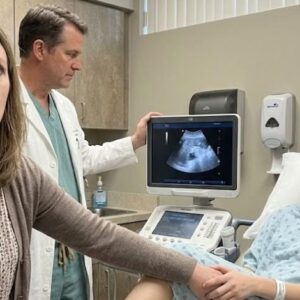
By 3:08 p.m., Maya was lying on an exam table beneath a thin paper sheet while an ultrasound technician moved a cold wand across her abdomen, capturing grains of pale shadows across the monitor before abruptly falling silent and leaving the room. Seven agonizing minutes later, Dr. Lawson walked through the door clutching his clipboard far too tightly, pulled a rolling stool close to the bed, and looked directly into my eyes with a grave expression that made the ceiling lights spin: “Mrs. Thorne, the scan shows there is something inside her—and we need to act immediately.”