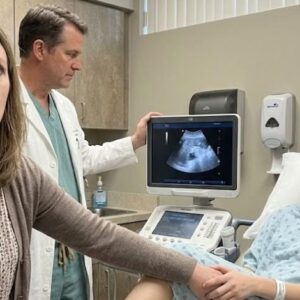
For a brief, terrifying heartbeat inside the dim ultrasound room at Riverside Medical Center, the entire world narrowed down to Dr. Lawson’s grave expression and the grainy pale mass glowing on the monitor beside my fifteen-year-old daughter, Maya. When Maya gripped my sleeve and whispered, “Am I in trouble?”—still conditioned by months of her father’s cold dismissal to apologize for her own physical suffering—my heart broke completely, even as I squeezed her ankle through the exam paper to anchor us both to reality.
Dr. Lawson leaned forward on his rolling stool, explaining carefully that the ultrasound had revealed a large, twisted ovarian cyst—a dermoid mass that had grown silently over months and was now cutting off blood flow, a condition known as ovarian torsion. He told us bluntly that what Robert had brushed off as “teenage drama” and “attention-seeking” was actually an acute surgical emergency; had we waited even another twenty-four hours to avoid a hospital bill, the tissue would have ruptured, leading to life-threatening sepsis and permanent damage.
Within forty minutes, Maya was prepped for emergency laparoscopic surgery. Sitting alone in the sterile surgical waiting room while my phone buzzed incessantly with furious, demanding text messages from Robert asking why we weren’t home yet, I felt every ounce of fear I had ever carried for his anger evaporate into thin air. When Robert finally stormed through the hospital double doors two hours later, red-faced and ready to lecture me about deductibles and wasted money, I met him in the hallway with Dr. Lawson standing right beside me.
Watching the color drain entirely from Robert’s face as the surgeon laid out the medical scans—showing him the exact size of the mass that had nearly cost our daughter her life while he complained about grocery bills and insurance co-pays—was a reckoning no argument could ever replicate. Robert sank onto a plastic waiting-room chair with his hands trembling over his face, confronted with the undeniable proof that his obsession with controlling money had blinded him to his own child’s agony.
Maya came through the surgery safely that evening, waking up in the recovery room free of the gnawing, relentless pain she had endured in silence for weeks. As I sat beside her hospital bed holding her warm hand while she drifted into the first peaceful sleep she’d had in months, I made a silent, unbreakable vow that never again would a checkbook, a deductible, or anyone’s convenience come before my daughter’s voice—because a mother’s instinct isn’t drama, it is survival.