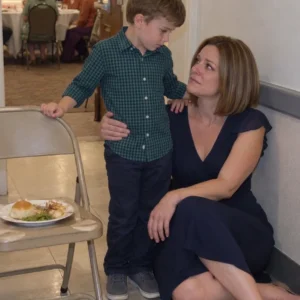
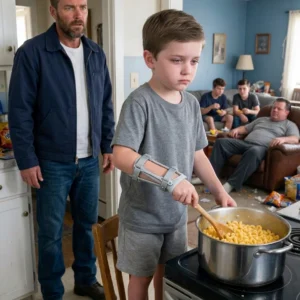
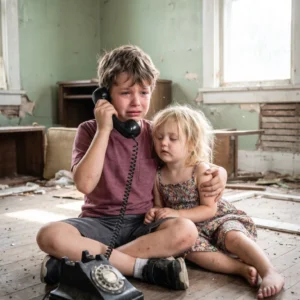
The following months were not easy. People rarely explain what truly happens after someone is taken into custody, as the dramatic scene of deputies escorting Dwight from our living room was only the beginning of a much longer recovery.
The harder reality began the next morning at a pediatric burn clinic in Lafayette, where a nurse named Ms. Odom carefully treated Finn’s injured arm while he stared upward and quietly counted numbers.
“Four hundred twelve. Four hundred thirteen.”
“Buddy, you can stop counting,” I told him.
“I’m not scared,” he said. “I just like numbers when it hurts.”
I needed a moment alone in the hallway. The physician explained that Finn would likely have a permanent scar, but fortunately, the infection had been identified before more serious complications developed. She added that another week without appropriate medical treatment could have resulted in a considerably different outcome.
Those medical records eventually became part of the evidence presented during the court proceedings, alongside interviews at the Children’s Advocacy Center where Finn spoke privately with a specialist named Ms. Vance for nearly fifty minutes. When she came out to the waiting area, she told me, “He’s very brave, and he’s very worried about you. He asked if you were mad at him. Three times.”
THE ROAD TO REBUILDING
After returning home, I contacted Ms. Tran, the speech therapist who had worked with Finn for two years before his appointments were abruptly stopped that spring. When I explained what Finn had experienced, she immediately offered to resume his sessions without worrying about the bill.
Meanwhile, the criminal proceedings advanced through the meticulous work of a prosecutor named Ms. Delacroix. Dwight’s defense attorney attempted to characterize him as “just a houseguest,” which created an unexpected conflict with Brandi’s legal team. Within days, Brandi’s attorney contacted mine to announce that his client wanted to cooperate fully with the court.
During the custody hearing, Brandi appeared thinner and unadorned, acknowledging her knowledge of the situation without making excuses. The judge awarded me full temporary custody and required Brandi to undergo an evaluation and gambling addiction treatment.
Brandi entered a residential treatment program in Baton Rouge, sold her SUV, and directed the proceeds toward the overdue mortgage payments. She attended every court-mandated session and wrote a weekly letter to Finn, describing ordinary moments like birds outside her window or books she was enjoying.
For four months, Finn refused to open them, and I completely respected his boundary. Then, one February afternoon, he asked me to read one to him to see if it was kind. The letter contained no demands, only a sincere apology and reassurance that he wasn’t responsible for what had happened.
Their first supervised meeting took place in April at a courthouse family visitation room. Finn approached his mother and whispered something before presenting his pet lizard in a shoebox with air holes: “I don’t know if I’m ready to hug you. But I brought Rig. You can say hi to him.”
For forty minutes, they sat together on the floor, taking their first tentative steps toward healing.
THE FINAL ENTRY
I continue working at the refinery twenty minutes away, maintaining my regular daytime schedule and arriving home before five each evening. The backyard swing set remains where I built it, and Finn’s little fort beneath the porch was completely rebuilt last spring with a proper door, a window, and an interior latch.
On the evening of Day 365, I discovered him sitting on our back steps, slowly typing with both thumbs on my old cellphone. Under the porch light, the pale crescent-shaped scar on his arm was still visible.
I lowered myself onto the step beside him. “You don’t have to keep writing, you know. You can stop whenever you want.”
“I know,” he said.
“Then why do you?”
He remained thoughtful and quiet for a little while. “Because the first twenty-six were for you to find. These ones are just for me. I like having a place to put the day.”
I wrapped an arm around his shoulders, and he leaned comfortably against me. “Can I read it?” I asked.
He turned the cellphone screen in my direction:
Day 365. Dad picked me up from school and was early. He’s always early now. I’m taller than the doorknob on the shed. I don’t think about the shed much anymore. Rig is fat. Mom’s visit was good. I laughed at something she said and then felt weird, but then it was okay. I’m learning that you can feel two things. Dad says that’s normal. I’m ok. I’m better than ok. I’m home.
I read his message a second time. Then something happened that had occurred only once before in my adult life—when I sat on the floor of a closet in Louisiana holding an old cellphone filled with unread messages.
I began to cry.
Finn gently placed his hand against my back and offered a suggestion: “It’s okay, Dad. You can write one too.”
I accepted his invitation, took the cellphone, and added my very first entry beneath his messages in our shared record:
Day 1 (for real this time). I’m here. I’m not leaving. I love you.
I handed the phone back to him. Finn read what I had written, gave a small nod, and said, “Send.”
“It can’t send, buddy. There’s no SIM.”
He smiled at me with that familiar, slightly uneven smile I had missed during so many evenings spent working far away from home.
“I know,” he said. “लेकिन it got there.”