The following morning, I met my brother Ethan near the church where his wedding was scheduled. He set a heavy brown box between us on the wooden table.
“I’m sorry,” Ethan murmured, looking down at his hands.
“For what?” I asked quietly.
“For taking so long to bring this to you.”
I lifted the lid. Inside lay copies of bank statements, Grandma’s handwritten messages, and photographs of legal documents detailing unauthorized property transfers. Beneath everything was an envelope bearing my name in Grandma’s unmistakable handwriting: “If you’re reading this, the truth has finally outlasted his lies.”
Ethan explained that Grandma had questioned Dad about the missing funds and intended to notify authorities before suffering her stroke, meticulously documenting everything instead. She had also noted that Mom had pleaded with her not to contact the police because she feared how Dad might respond.
THE CONFRONTATION AT THE WEDDING
Before the wedding, Ethan and I brought the documents to an attorney. After examining the records, the lawyer uncovered something neither of us anticipated: Dad had pledged Grandma’s former property as security for a private loan, despite never having legally owned it, and intended to pressure Mom during the wedding gathering into signing transfer documents.
Ethan immediately canceled those legal traps and revised the guest list.
The following day, I attended the ceremony. Dad stood beside the entrance, looking directly at me with a hardened expression: “You shouldn’t be here.”
“You told me that twenty years ago,” I replied calmly.
“You don’t understand—”
“I understand everything now,” I interrupted.
Mom stood behind him with tears welling in her eyes. Ethan stepped forward between us: “Dad, this stops today.”
Dad stared at him, stunned: “You’re taking her side over mine?!”
Ethan slowly shook his head: “No. I’m standing with the truth.”
At that exact moment, our attorney arrived carrying the financial documents, accompanied by an official process server. Dad’s expression immediately shifted; nobody argued or caused a scene, because he finally realized he could no longer dictate the family’s version of reality.
Mom finally moved closer, her voice shaking: “I should have protected her.”
Dad looked at her sharply: “You never said anything!”
“I know,” she brushed away her tears, turning toward me. “I was wrong.”
Hearing those words was unexpectedly painful after spending twenty years hoping for an apology. Still, I didn’t rush forward to embrace her. I merely nodded, recognizing that fear might explain her silence, but it could never undo its lasting consequences.
A NEW FUTURE BUILT ON TRUTH
The legal proceedings continued for months, with our attorney successfully contesting the proposed transfer, recovering stolen funds, and permanently securing Grandma’s property.
Ethan celebrated his wedding without requiring me to carry the heavy burdens of my past. Before the ceremony began, he hugged me tightly and whispered, “I’m happy you’re here.”
“So am I,” I smiled back.
Mom and I met on several occasions afterward. Our relationship never returned to its earlier form, but with time, we learned to communicate honestly.
Meanwhile, I stopped defining my future through the family I had lost. I developed a successful career, purchased a modest home, and surrounded myself with true friends who valued me for who I was, rather than the false narrative Dad had constructed.
I stored Grandma’s last letter inside a locked drawer. Her reminder that I had been just a child was what I needed to understand most: I had never deserved a.ban.don.ment.
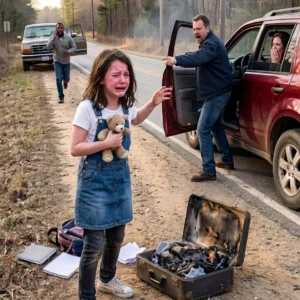
Twenty years after my father destroyed my suitcase beside that desolate road, I finally recognized the truth. The little girl standing there believed her family had erased her existence.
They hadn’t. They had merely stepped away from the bright future she would eventually create on her own terms.